Posted by Krystal Navar on Thu, Oct 20, 2011 @ 08:34 AM
In our last post on the Roberts Avenue Residence, we took you through the schematic design process -- at least how our office goes about it. If you remember, the client picked Scheme A, which consisted of a series of shifting bedroom boxes on the ground floor, visibly and audibly sheltered from the neighboring park. The living level and guest bedroom were located on the upper floor, taking full advantage of the views over the park and beyond to Baldwin Hills.
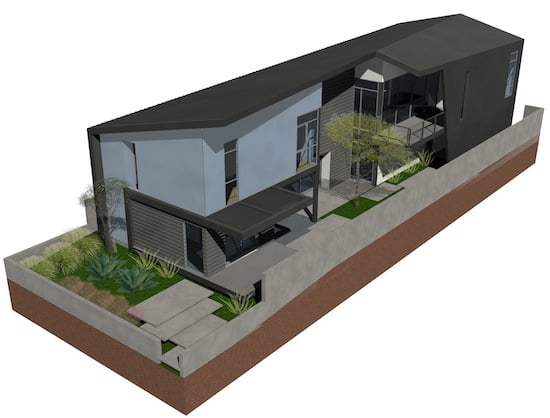
To refresh your memory, here’s an image of Scheme A during Schematic Design.
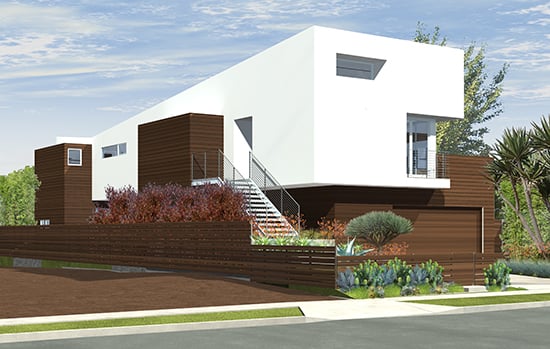
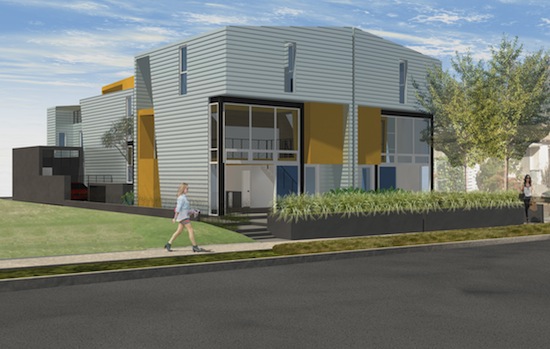
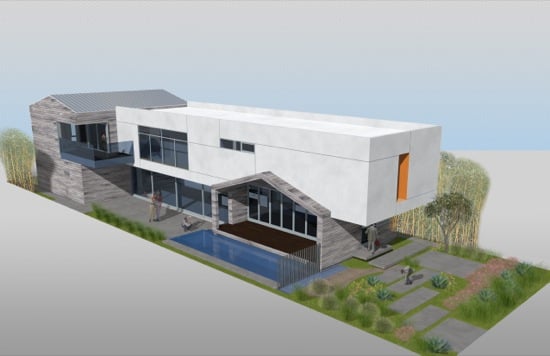
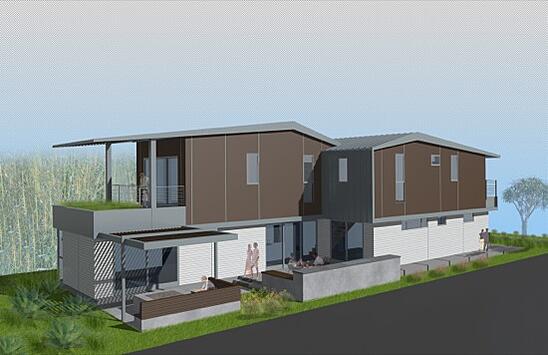
You will see that the driving concept remains in the final design: quiet, spa-like spaces on the ground floor and open, airy spaces on the second floor. Although, there have been some adjustments. For instance, the guest bedroom and the master bedroom swapped locations. The client felt that the master bedroom, with it’s own private balcony on the second floor, would better benefit from the views. The bedroom volumes also shifted to alleviate the need for excessive steel structure to support unnecessary cantilevers.
First Floor Plan

Second Floor Plan

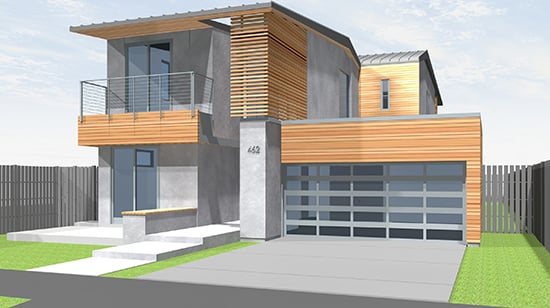
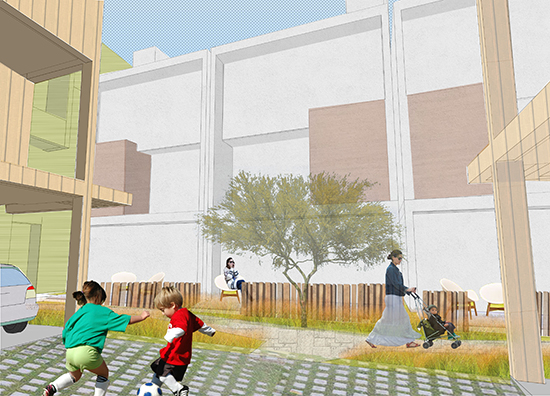
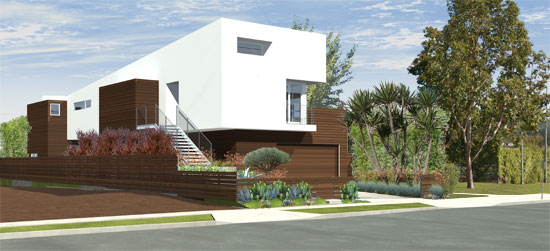
Rendering

Rendering
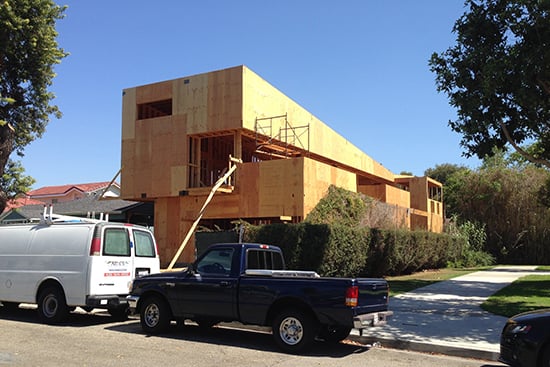
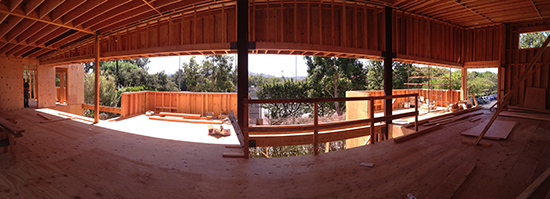
We have submitted for permits and are now waiting to receive comments back from the City. Once that happens, and we make the necessary corrections, bidding begins. Construction is expected to start by January 2012. Look for more updates to come with photos of the construction process.
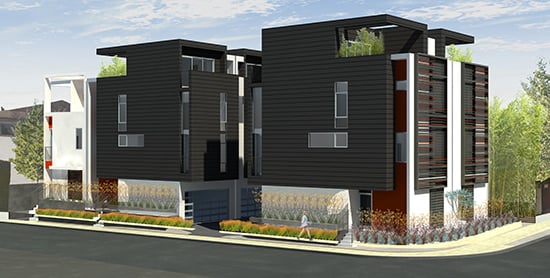
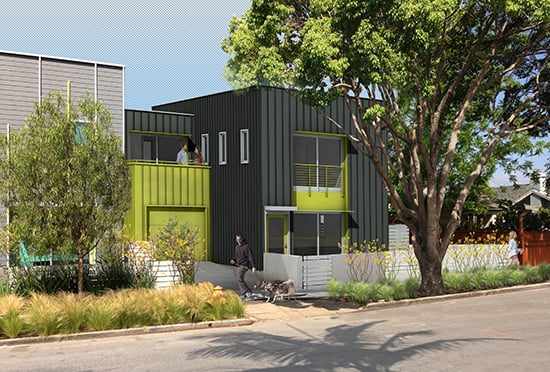
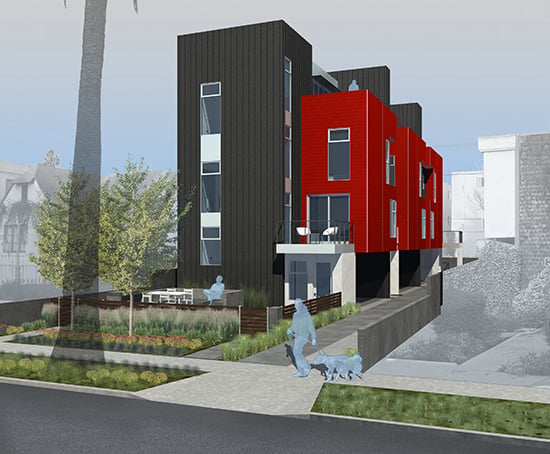
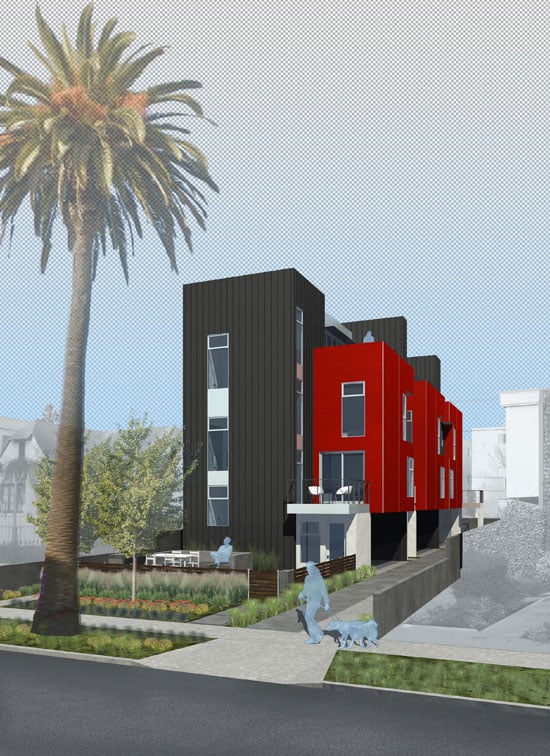
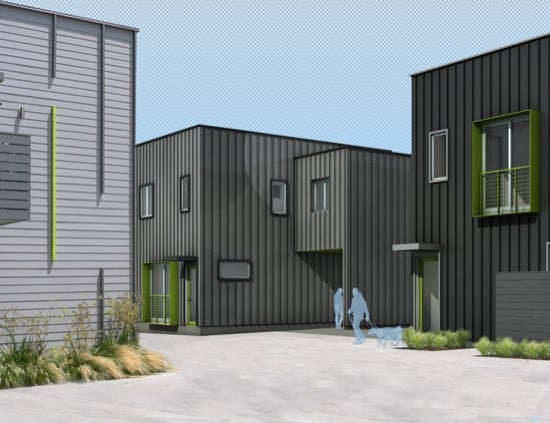
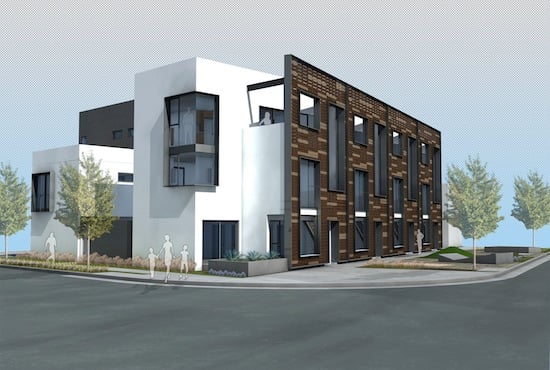
But, before we part, this is the perfect time to introduce our next project. As many of you know, a happy client on one project can lead to a happy repeat client on a new project. Our client on the Roberts Avenue Residence recently purchased a property on Fay Avenue -- a mere 0.2 miles from our office -- on which he wants to build 4 small-lot homes. This property is in Los Angeles, so it can take advantage of Los Angeles’s Small Lot Subdivision Ordinance. I know! What a great fit for Modative! (If you’re not familiar with the Small Lot Subdivision Ordinance in Los Angeles, click on the link and read up! It’s pretty cool (and, really, my only hope for brand-new home ownership in LA.)
Fay Triangle Site Plan
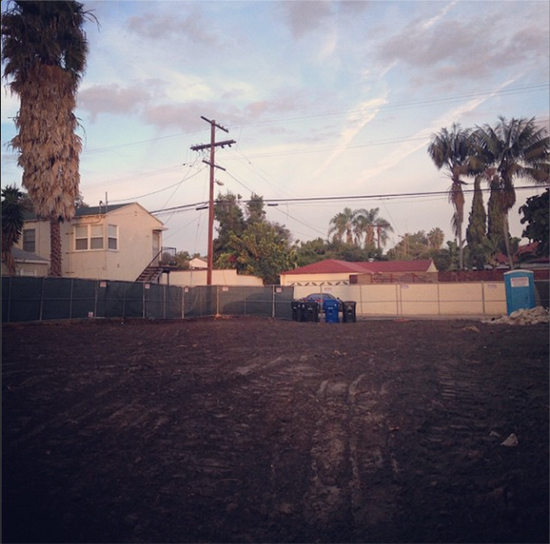
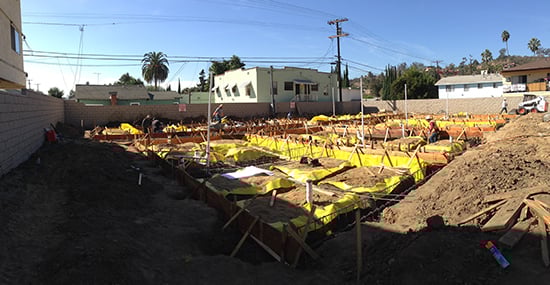
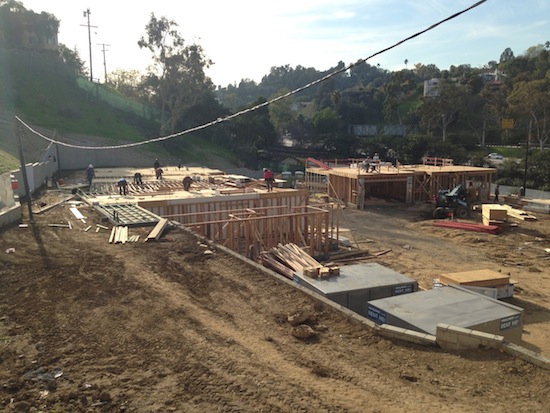
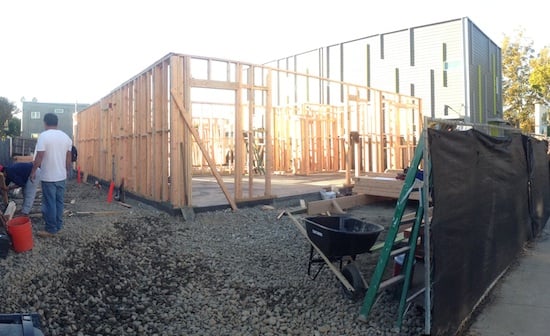
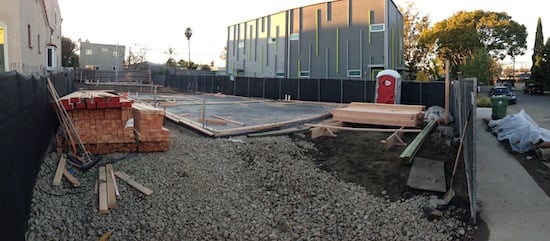
Photo of Fay Triangle site taken from adjacent building
We are excited about this new project for two main reasons. First, we have been eyeing this triangle-shaped property for the entire five years our office has been in the area, long before it was even up for sale. (I was hoping it would somehow be left to me in someone’s will, but that would have been highly unlikely.) Second, this property is only four properties down from our Fay 2x Homes project. To have so many projects located within a mile radius of one another (in our own neighborhood, nonetheless!) has been really special. We have the rare opportunity to inject this area with thoughtful, modern design. (Check out our other projects in the area: Cullen St. Homes, Fay 2x Homes, Roberts Avenue Residence, Venice Urban Dwellings.) Stay tuned for updates on this new project we’re calling Fay Triangle.

Map of Modative projects in our neighborhood
Post by Krystal Návar. Contributors to this post include Christian Návar, Derek Leavitt and Michael Scott .
Posted by Krystal Navar on Thu, Jun 23, 2011 @ 08:30 AM
Different architecture firms approach the design process in different ways. Here at Modative, we are beyond thorough. Recently, we began working on a new single-family residence in Culver City, CA, a stone's throw from our office. We thought it would be fun to take you through Modative's design process, using this new project, Roberts Avenue, as the example. So, here it goes.
Before pen ever meets paper, we undergo a thorough site analysis. Many firms skip right on by this, what we feel to be, the crucial first step of the design process. We believe that the site should influence the design. Our site analysis covers topics such as physical site conditions, prevailing winds, street grids, circulation to and from the site, views in and views out, noise, and neighborhood character.

3 diagrams showing views, noise, and pedestrian access

View north on Roberts Avenue

View from what will be the second floor of the new house

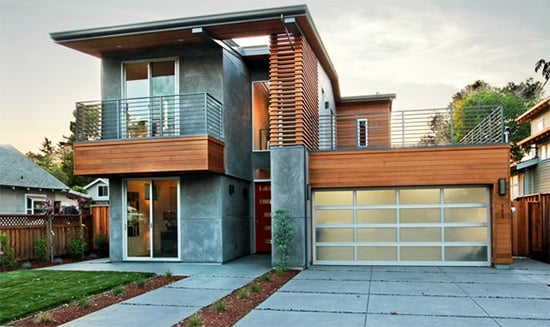
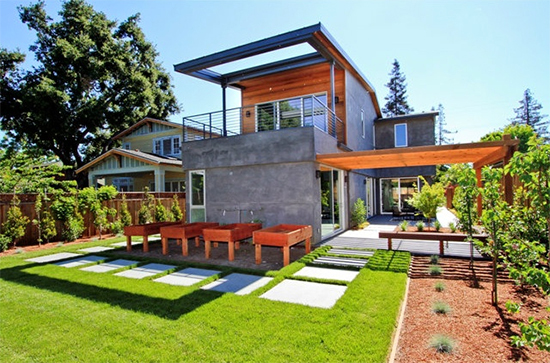
A few interesting modern homes in the neighborhood
We keep the client involved in every step of the process, so once we've hashed through the site analysis, we present the information we've gathered to the client. We figure that if the client is with you through these initial steps, once you get into the schematic design phase, the sketches you show him/her will not seem to have come out of nowhere. Most importantly, the decisions you are making will not seem arbitrary -- they will be rooted in your initial site and precedent studies. Both you and the client will be able to reference back to this gathered information as the design progresses.
At this point, during our first presentation to the client, we also discuss the project's program, budget, and schedule. Once we have a better understanding of these three criteria, we launch into the design of the building. On this project, our intern, Jonathan Ackerman, built a series of small massing models at 1/16"=1'0" studying possible configurations based on allowable square footage and the influences of the surroundings. This is where the site considerations previously mentioned come into play. Knowing that this site is located next to a public park and across the street from an elementary school informs how the masses are organized.

4 massing models by Jonathan Ackerman
The next step is to sit down with everyone in the office (all 5 of us at the time) and brainstorm. We give the same presentation to the office that we gave to the client and go through each of the massing models. Then the trace paper is rolled out, everyone gets quiet, and starts feverishly sketching. This is the fun part. (I like to stop sketching 5 minutes into it, take a peak at everyone else's sketches, and let my thoughts be catapulted in a completely new direction.) This is the time to not hold back. Every idea is possible.

Sketches of what will become Scheme A
When everyone has exhausted their supply of trace, each person explains their thoughts to the group. (It's amazing how, after seeing the same site analysis presentation, everyone's schemes have common threads. It shows you that the site really does drive the design.) Once we've thoroughly dissected each person's concepts, we settle on 2-3 schemes that the project designer will further develop to show the client.

Sketches of what will become Scheme B
Before starting to develop these schemes, we research relevant precedents. Inspiration and direction both come from studying what others have done to solve problems similar to those you are facing in your design challenge.


Precedent images taken from slides from our client presentation
At this point, the project designer takes everyone's sketches and began translating these sketched concepts into actual floor plans and massing models in ArchiCAD. We decided to continue to develop 2 of the schemes that came out of our in-office charrette.
After these floor plans were developed enough to talk about, we had another quick meeting with the office to get input from everyone on any minor adjustments that need to be made.

Scheme A draft renderings

Scheme B draft renderings
Maintaining this idea that the client needs to be brought along beside us every step of the process, before we even show floor plans and renderings, we show some 3D diagrams explaining the reasoning that is informing our design decisions.


Scheme A diagrams

Scheme B diagrams
At this point, all of the layouts are in ArchiCAD. However, we choose to sketch over print-outs of the layouts and show these sketches to the client instead of showing them hard-lined floor plans. Hard-lined floor plans, this early in the design process, give the impression that everything is figured out and that it's too developed to make changes. It's important, at this stage, for the client to feel that their input is welcome and that the design is a malleable thing, not a fixed thing. We also show "sketchier" renderings instead of realistic-looking renderings.


Scheme A sketchy floor plans and renderings


Scheme B sketchy floor plans and renderings
At the end of our presentation of these 2 schemes to the client, the client picks 1 scheme to run with. (They picked Scheme 1. They like -- and so do we -- how the living is on the upper floor to take advantage of the views.) Once 1 scheme is chosen, we have finished the Schematic Design phase and move into the Design Development phase where the floor plans are tightened up, the look of the building is massaged, and materiality that supports the concept is explored. The Schematic Design phase, when all of the above steps are taken, serves to lay the framework for all of the decisions made in the Design Development phase. This is critical in the development of a thoughtful, relevant design.
Post by Krystal Návar. Contributors to this post include Christian Návar, Derek Leavitt and Michael Scott .
Posted by Derek Leavitt on Wed, Jun 22, 2011 @ 12:06 PM
2011 has been quite a year here at Modative. After utilizing our "be cheap" and "start and stay small" philosophy to get through the tough architecture/real estate market of the last few years, 2011 has required us to make a change.
After an increase in projects this year, we found ourselves very busy and in need of some help. While exciting, the thought of expanding was a bit unnerving, because while Modative is a business, it's also a bit like a family. The three Modative principals have known each other for over 15 years. This level of trust allows for complete honesty amongst the group - a key ingredient to design and business success.
So, when the time came to expand, we decided against a big search, but rather to keep the "family" connection going by bringing on Christian's wife, Krystal Návar. Krystal's well-rounded architecture experience fit well with our needs. Besides, Krystal already felt like part of the Modative team. She has shot photos of our projects and has been our blog editor since its' inception. Nothing has been posted on this blog without her prior review. While she will continue in this editorial role, I'm happy to announce that Krystal will also be authoring blog posts starting immediately. Since she's a better writer than the rest of us combined, we're excited to have her help on the blog.
We thought a great intro post would be for Krystal to document the design process of a new single family residence we've been working on since her arrival here about a month ago. This blog post will be up later this week. In the meantime, feel free to check out Krystal's profile on our website.

Welcome to the team Krystal!
Posted by Derek Leavitt on Tue, Jun 07, 2011 @ 05:07 PM
A Better Way to Build
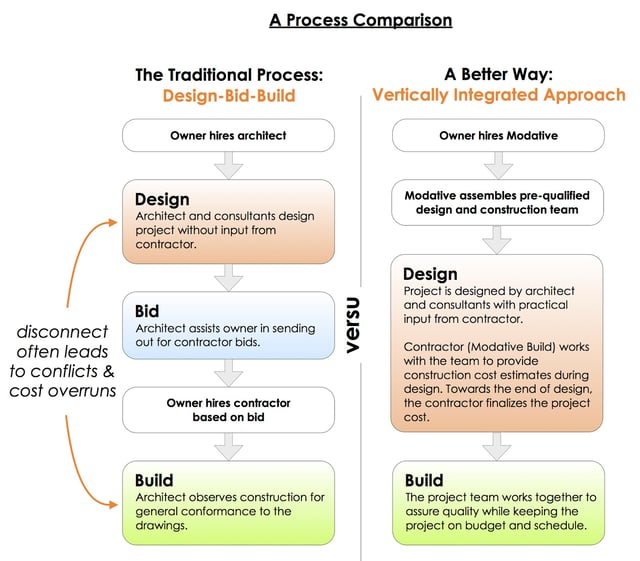
Modative was founded in 2006 with the goal of making modern design more affordable. Since then, we have been an architecture-only firm -- until last year when we formed a separate construction company called Modative Build, Inc. to provide our clients with an alternative to the traditional and often unsuccessful owner-contractor-architect relationship triangle. By having our own construction company we can now offer our clients a streamlined approach to getting their projects built at a reduced cost with far less headaches. Learn more about our approach.

What You'll Be Working On
Although you may be occasionally asked to do a coffee run, this is not one of those kinds of internships. This is a hands-on, learn-though-real-experiences type of internship. You will not be directly constructing anything, but rather working on what really makes all construction companies tick: coordination and problem solving.
Bidding
Your primary responsibility will be to coordinate the bidding of several projects that Modative (the architecture company) has designed. You will work hands-on with the project designer and learn about all the trades that are required to put a real project together. You'll bid those trades out to subcontractors, then compile the selected subs into a beautiful, comprehensive bid. The projects you'll be bidding are primarily residential, type V construction. They are all modern.
Construction Management
You will also help us with the Fay 2X Homes, which are currently under construction a few blocks from our office. You'll get to see the construction process of these two homes happen first-hand, while also helping the project manager with behind-the-scenes coordination.
Collaboration
The construction company (Modative Build, Inc) and architecture firm (Modative, Inc.) operate in the same small office space without any cubicles. We're low on hierarchy and high on collaboration, so you might get pulled onto any number of projects.
What We're Looking For
We're looking for someone with an architecture or construction education/background, who like us, sees the importance of overlapping these two professions to achieve a greater goal. Someone that wants to turn the antiquated construction industry on it's head and that can use their design and organizational skills to bridge the architecture/construction gap.
If we like you and the opportunity arises, this internship could lead to a full-time position at Modative Build or Modative.
Bonus Points
You'll be using ArchiCAD, Numbers (Apple's version of Excel) and QuickBooks. Knowledge of these will help your learning curve. Spanish speaking will earn you extra points. We're also fans of creative resumes.
How to Apply
Send us a resume, portfolio and whatever else makes you look good to info@modativebuild.com .
To avoid spam, please include (MB Internship) in the subject line. Also, please provide short, concise answers the following questions in your email:
1. Please describe your current level of experience/education in the architecture and/or construction industry. If you're still in school and this is your first job, that's fine too.
2. Do you have experience with any CAD or BIM software?
3. Do you have experience with Excel and/or Numbers?
Schedule
We will be accepting applications until 6 pm PST on 06.09.11. From the applications we receive, we will narrow it down to 5-10 candidates for 15-minute speed interviews on 06.13.11. Follow-up interviews will be conducted later in the week if necessary. The internship will begin on Monday, 06.20.11 and last until late August or late September 2011.
Internship Location
Modative Build, Inc8734 Venice Blvd. Los Angeles, CA 90034Map
About Our Location: We're two blocks east of Helms Bakery, adjacent to the Culver City Arts District and within walking distance of several coffee shops and restaurants. It's a great central location in the LA basin.
Posted by Christian Navar on Thu, Apr 21, 2011 @ 08:28 AM
When Modative started in the Spring of 2006, we formulated a firm philosophy that included making modern affordable (and not just because the economy was about to tank). Our intention was to create a business operating structure that didn’t have to rely on generating income solely off of huge, elaborate commissions. Early on, we strived to create a firm that embraced projects of varying type and size, in order to satisfy our mission to make good design accessible to as many people as possible. So, if you call and say that you love good, modern design, but have a very limited budget, we will still consider the job.
A Small(er) Job
Recently, we received a call that aligned perfectly with our firm philosophy. Not only did our clients have a very limited budget, but they also had a tight and strictly defined schedule. “We have a baby on the way... in 7 months to be exact. We need bedrooms now!”

Project Schedule
The project site consisted of an existing 1300-square-foot open loft space within a large multi-unit property. Our task was to take the hip, open loft space, and make it a bit more practical.

Floor Plan Diagrams
The Challenge: Split the open loft space, adding two bedroom areas, but maintain the “lofty” quality of the space.
The Result: A Volume, A Wall, & The Doors
A Volume

Rendering of new volume (nursery)
A volume was designed to shelter the new baby. Within the volume is the nursery. Aside from the bathrooms, the volume is the only fully enclosed, fully sound isolated, traditional bedroom space in the unit. It is the perfect space for a sleeping baby (not to mention a good room to contain the terrible 2’s!)
At the clients' request, an interior window was provided, allowing them to peek into the volume without disturbing their sleeping baby. Photo by Krystal Návar
Photograph of new volume (nursery) from the entry. Photo by Krystal Návar
A Wall

Rendering of the new wall from the living room
A wall was created to define the space between the living room and the bedroom/office area. Within the wall is much needed storage. A new closet is accessed from the bedroom side of the wall, while a new pantry is accessed from the kitchen side.
View of the new closet from the bedroom side of the wall. Photo by Krystal Návar
The Doors
View of the new wall with the doors open. Photo by Krystal Návar
Within the new wall are a series of sliding, bypassing, pocketing barn doors. When closed, the 10’-0” tall doors provide privacy for the bedroom/office area. When opened, the large openings create definition, yet openness, within the lofty space.
View of the new wall with the doors closed. Photo by Krystal Návar
Post by Christian Návar. Contributors to this post include Krystal Návar, Derek Leavitt and Michael Scott .
Posted by Christian Navar on Wed, Feb 09, 2011 @ 09:32 AM
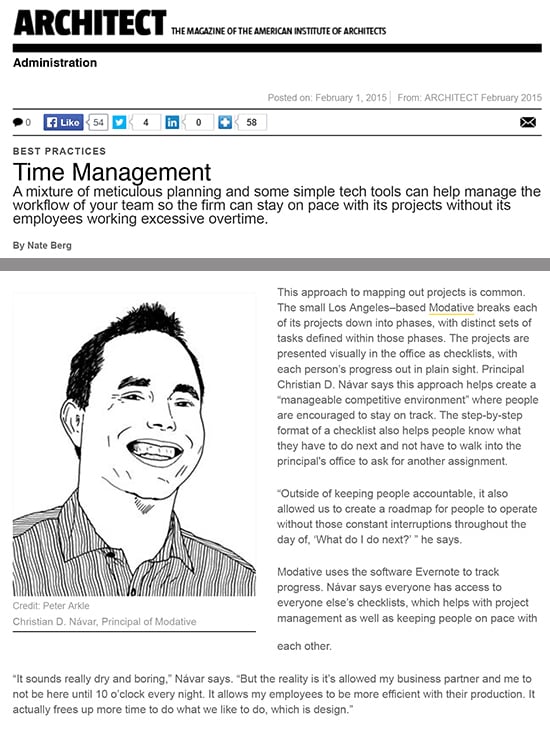
When we founded Modative we went through a lot of exercises to create a strategic plan for how to organize the business operations of our design firm. Business operations is a subject matter rarely touched on in Architecture School let alone in most design firms. In fact, most firms operate in the same chaotic manner in which an undergraduate architecture student operates when struggling to weave an endless amount of work into a cohesive final project. Bad decisions, unclear goals, and a lack of clear action items inevitability leads to mass consumption of caffeinated drinks, all-nighters, and mismanagement of time and energy. These bad habits, first developed at a young age, are very hard to break and continuously infect most firms’ culture, becoming an endless cycle of mismanaged projects, bad decisions, and bad ideas. All you have to do after interviewing most architects is drive by after hours and see if the lights are still on or call on the weekend and see if someone answers the phone.
At first, you may think this is the sign of a hard-working office, but most likely it is a sign of poor firm culture, bad project management, and burned-out project teams. At Modative, we are all for hard work, and I would be lying if I said we never work extra hours or on weekends, but there are a lot of firms that run their studios like sweat shops. Not because they have to, but because they have no other choice. The continued mismanagement of project operations and lack of prioritizing and internal communication means mass amounts of energy are spent on tasks that may seem urgent at the time, but really are just the result of poor decision making, over-promising to clients, and a clear lack of short and long-term objectives throughout each phase of a project.
“The Clothesline”

The first book I purchased on my iPad was Making Ideas Happen, by Scott Belsky. After reading about various strategies and concepts regarding methods for implementing ideas and achieving results, I realized it was time to revisit Modative’s strategic plan. It was time for our business operations to evolve into something even better. There is a section in the book that discusses using “progress as a motivational force.” So we modified some concepts found within the book and developed our own strategy to clearly identify action items by “surround[ing] ourselves with progress”. We start every Monday morning by sitting, not in the conference room, but in front of our “clothesline”: a wall made up of a series of horizontal steel cables from which 11X17 sheets of paper are hung from clips, clearly identifying projects, their schedules, and crucial action items that prioritize every project’s goals.
Some of this week's goals
We intentionally didn’t make each project sheet overly complicated. Each page has a project logo, a color, and a title. Each item gets assigned by the project manager to a team member, along with a due-date and a check box to show when each item has been completed. The system allows for very little mis-communication and prioritizes each item so there is never any confusion about what should be worked on when. Our goal at the start of every week is to ensure that we are focusing our energy on things that truly matter that week, will make our projects better, and make our clients even happier. Through “visual organization,” we have been able to develop a system that has become integral to our office’s creative process, keeping us focused and even more engaged then ever before.

No matter how creative the team, mismanaged office operations lead to the loss of a project’s full potential. A project may seem great in the end, but let’s start thinking about how much better things could have been if a project’s full potential was realized by a team that wasn’t dragged through the trenches along the way. Even award-winning firms suffer from disastrous mismanagement of project operations. Often, long after the AIA award is on the wall, the client and the office are still in recovery mode. The financial ramification brought on by a lack of a clear strategic planning to balance the creative excellence within a firm, can kill morale and ultimately affect everyone’s productivity let alone everyone’s bottom line. In Scott Belsky’s book he explains, “that everything in life is a project, and every project must be broken down into Action Steps...” Well, at Modative, everything really is a project. I’m just glad we are able to rely on our “clothesline” to clearly organize and prioritize our ideas and actions. This way, our clients can be confident that we will inject all of our energy successfully towards reaching their project’s goals.
Being organized allows us ample time to do what we love most: designing and being creative, while still having plenty of time to enjoy life and walk Bella, Modative's office dog.
 |
 |
Bella- The early years (before lots of walks)
|
Bella- after more organization (& after lots of walks) |
Contributors to this post include Krystal Návar, Derek Leavitt and Michael Scott .
Posted by Derek Leavitt on Wed, Dec 08, 2010 @ 09:30 AM
One of the most difficult client types to gauge when they first contact our architecture firm is single family residential clients. We often find ourselves asking them the same questions from memory in order to determine our architecture fee and if their project is a good fit for our office.
After repeating this exercise all too often, we decided that there was an easier way. So we wrote up a list of 10 questions for potential residential clients to answer. This was not an attempt to remove the personal touch of discussing a clients potential project over the phone or in a face-to-face meeting, but a way to be thorough in collecting all the basic information that helps us write better proposals that cater to the client's needs.

Would you like a pool house with that?
The idea was to email the questions over as a follow up to that first phone call. We decided to keep it simple. Make it multiple choice when we could and encourage short answers. Our previous attempts to create questionnaires like this were often bloated, causing our clients to feel overwhelmed and hesitant to complete them.
We created the document in Pages (Apple's version of Word), but then converted it to the more universal Microsoft Word format. As it says at the top of the document, the client can choose how they want to fill it out and return it to us.
Here's our 10 question Residential Project Checklist in its full format. A link to download this as a Word file is provided at the end of the post.
-----------------------
Residential Project Checklist
10 quick questions to help us better understand your needs
1. Your Name: Jane Doe
2. Phone Number(s): XXX.XXX.XXX
3. Email Address: janedoe@gmail.com
4. Spouse/Partner’s Name (if applicable): John Doe
5. Project Address:
101 Terrace Ave
Los Angeles, CA 90000
6. My project falls under which categories (place an X in front of all that apply and briefly
describe):
__ Ground-up Residential
Size: XXXX square feet
Quick Description: Add quantity and type of rooms
__ Residential Remodel
Size: XXXX square feet
Quick Description: Add quantity and type of rooms
__ Residential Addition
Size: XXXX square feet
Quick Description: Add quantity and type of rooms
__ Pool/Pool House
Size: XXXX square feet
Quick Description: Add quantity and type of rooms
7. What is your estimated budget for the construction project?
__ less than $25,000
__$25,000 - $75,000
__ $75,000 - $150,000
__$150,000 - $250,000
__ $250,000 - $500,000
__ $500,000 - $1,000,000
__ over $2,000,000
8. If you have a schedule in mind, please explain below:
I’d like to start construction on this project in blank months.
9. If you are doing a remodel or addition, do you have any existing plans of the house? (please
mark all that apply):
__ I don’t have any plans.
__ I have physical copies of the plans (like old blueprints).
__ I have digital copies of the plans (like .dwg or .pdf files).
__ I drew up the plans myself
10. Anything else you care to share about your project?
Things you must have? Ideas on green design?
----------------------------------------
Here's a link to download the Residential Client Checklist
If you have any suggestions or key questions you think the list is missing, please feel free to add them in the comments.
Contributors to this post include Christian Návar, Michael Scott and Krystal Návar.
Posted by Christian Navar on Wed, Nov 17, 2010 @ 08:24 AM

Spent too much on land?
For years in our industry I used to hear how architects know close to nothing when it comes to staying on budget, that overspending is commonplace for most designers. With the severe downturn in the real estate industry it seems like architects finally aren’t the only ones who can be accused of overspending!
Like many Los Angeles architecture firms, many of our prize projects have been scrapped in the last couple of years. Our projects became victims of overspending, and this time, you can’t blame the architect for over-designing, ignoring budgets and having cost overruns.
These days it is now clear that spending too much on land and planning oversized projects has become the real project killer.
So, you bought too high you say? Now what?
So, you bought a property at the height of the building boom and now your budget numbers don’t look so good and you need to put the project on hold? Hmm, if I had a dollar for every time I have heard that in the last year, Modative could bail us all out of this crisis.
Being designers, we of course naturally believe that you can design your way out of anything. Here at Modative, we believe that if the government hired more designers, or real problem solvers, we would need less “financial experts” and definitely less slow-moving bureaucrats. If you think members of the Obama Administration are the only ones offering bailouts these days, you should check out our new 2-unit small lot subdivision “stimulus package”.
Modative’s stimulus package
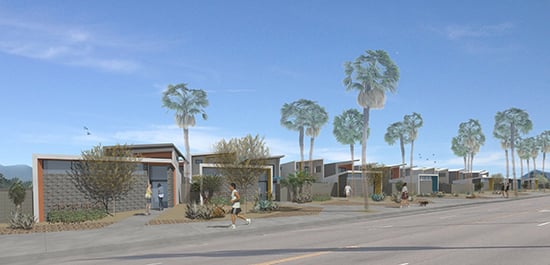
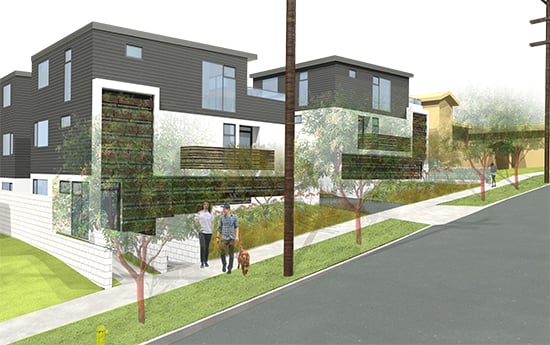
The project site is currently vacant land that sits between two other lots that combined were once part of a 7-unit small lot subdivision project on Fay Avenue in Los Angeles. After the economy crashed, the project was placed on hold, and our client found themselves with an overpriced and underutilized piece of dirt.

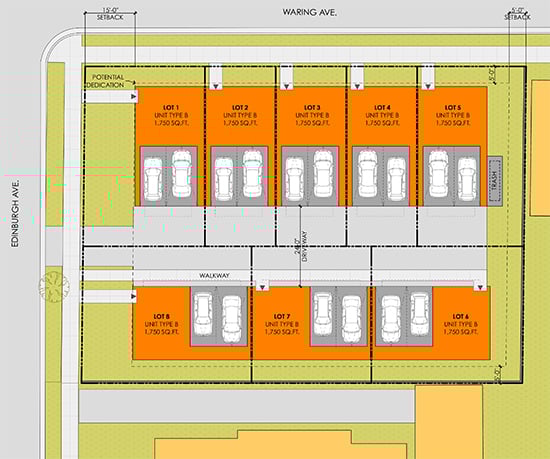
In classic boomtown fashion, the original project consisted of seven luxury three-story units that were slated to be between 1,750 and 1,900 square feet each. After the bust, the client asked us to reevaluate the site, specifically the vacant dirt lot, and propose a simple, cost-effective solution that would bring added value to this property which wasn’t generating any income.
Creative solutions can revive a project
This isn’t our only revisited post-downturn, multi-unit housing project currently on the boards. In fact many of our recent projects have come to us as previously-approved condominium projects designed by other firms. Aside from being asked to turn defunct condominium projects into small lot subdivisions, we hear the same thing over and over, how small can we make a residential unit and still have it be marketable?
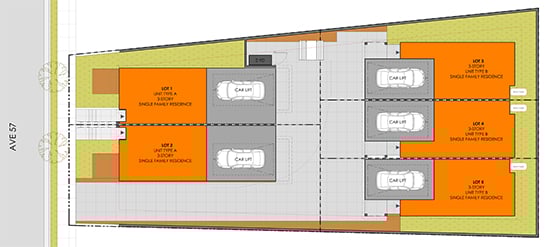
In the case of the Fay Avenue project, we proposed starting out with just two very simple two-story, 1,000 square foot, 2 bedroom, 2.5 bath units that could be offered at a price point more favorable in the current marketplace. We then devised a creative phasing option, placing the proposed units on the site so that the owner could utilize the other two lots as part of a future phased expansion, that in the end will total 7 units. In the meantime, they could continue to rent the units on the other lots and wait for the economy and the current lending situation to improve. We have always believed in smaller units, but now, with the current state of the economy, we can finally get people to believe that bigger isn’t always better.

We were proud of our original 7-unit project, but sometimes you have to cut your losses and move on. In the meantime, we’ll continue to take pride in knowing that our redesigned 2-unit “stimulus package” will help provide an added income stream for our client.
An architecture professor of ours from USC once said, “I am teaching you how to solve problems, not so you will become good architects, but so you will become great politicians.” Well with the current unemployment rate in California hovering somewhere around 12.4%, anything Modative can do to be part of the solution is something to be proud of.
“The first phase of the Fay Avenue project is slated to begin construction in the Spring of 2011. The Obama administration is still running some calculations to determine the exact number of jobs this project will add once construction begins, but thanks to Modative, we are pretty sure not only will this project be beneficial to job creation, but maybe, just maybe, it will even help stimulate small businesses lending again!” - Unknown Politician
We plan to post project updates on our website regarding this project, so if your’re interested continue to check back for more info.

Contributors to this post include Derek Leavitt, AIA, Michael Scott and Krystal Návar.
Posted by Christian Navar on Tue, Sep 07, 2010 @ 08:15 AM
People often contact Modative about a project they have in mind, but they are often unsure of how to get started. Common questions we receive are:
- How much will it cost?
- What will the city allow us to do?
- How much square footage can I build?
- Is it feasible?
- How many units can I build?
- How much parking do I need to provide?
- What is the process?
- How long will it take to permit or build?
- I have a lot / want to buy a lot / want to lease a property. What can I do with it?
Modative was recently contacted by two individuals who posed many of the questions listed above. The first individual was a long-time business owner with a hard-to-lease commercial auto body shop in Los Angeles. The second was a young entrepreneur looking to find a property in order to open a new restaurant/bar concept. With both of these clients, their long term plans were contingent upon taking really important first steps to decide what to do with the property they own/lease/were looking to purchase or lease.

Our services often include conceptual renderings like this one for the aforementioned restaurant/bar in Los Angeles. These renderings are valuable tools for our clients (and their investors) to envision the project's possibilities.
Since the economic climate has shifted downward so dramatically, more and more of our clients are requesting that we provide answers to important questions in order to guide them in the decision-making process before they spend too much of their cash reserves. In our ongoing efforts to give people insight into the helpful services we provide here at Modative, we’d like to share a service in which several of our recent clients have had a particular interest: Site Evaluation and Planning Services.
The beauty of our Site Evaluation and Planning Services is that within a few weeks, for a smaller financial commitment, we can provide valuable insight into what can be done with a property. The level of detail provided in our analysis is catered to the clients specific needs. Some just want the basics, like of what uses are allowed and the code restraints, while others want a more detailed investigation, like program development, preliminary layouts, conceptual renderings, and even preliminary budget analysis of construction and soft costs (architectural, consultants and city fees).

A descriptive 3D Plan we provided as part of the Site Evaluation and Planning Services for an auto body shop conversion into office commercial.
While we frequently provide these services for ground-up projects such as Residential
Small Lot Subdivision projects, we also do quite a few for residential and commercial rehab and remodel projects.
Check out our Site Evaluation and Planning Services page to download a sample report we developed for a commercial rehab project and learn more about how these services are a great way to get a project started without a huge upfront commitment.
Download a sample Site Evaluation and Planning report:
|
A sample case study of a commercial rehab and former auto body shop in North Hollywood, California.
|
Contributors to this post include Derek Leavitt, AIA, Michael Scott and Krystal Návar.
Posted by Derek Leavitt on Tue, Jul 27, 2010 @ 09:31 AM
To us here at Modative, modern architecture is really more about a way of thinking than a style. It's about doing things better, even if it means abandoning old traditional rules. We carry this same critical thinking into the occasional graphic design assignment. An example of this recently occurred with our business cards.
Architect's Business Cards
Four years after our initial order, a few of us were running low on business cards. The natural architect instinct is to redesign the entire card; however, since we're still happy with our logo and look, we decided on only a few minor modifications. Subtracting instead of adding - much like we would do in a building design - eliminating the unnecessary.

No changes to the back of our business card. We like the bold simplicity and abundance of orange that screams "pull this business card out of the jar for the random prize drawing".

The front of our old business cards.
The first subtraction was an easy call: nixing the fax number. Honestly, we don't want faxes. We've contemplated eliminating our fax machine altogether. Anything that can be faxed can be scanned and emailed.
We also considered removing our physical address. The physical address on our business cards has actually been the cause of confusion over the years because it listed our mailing address, not our office location. When we originally designed the cards, we did this intentionally, because we knew we'd move our office a few times in those early years. And we did.
Unfortunately, more than one person has shown up at our mailbox for a meeting. Since we don't want two addresses on the card (too much clutter), we narrowed it down to three options:
- Keep the mailing address
- No address, but have "Los Angeles" to give people a sense of our location
- Go with no address or city and rely on people going to our website to find our two addresses.
Variations of the "Los Angeles" Option. We didn't like the way "Los Angeles" looked on the card. It was as if we forgot the rest of the address.
In the end we decided on Option 3: no address. People have much better access to the web than they did even four years ago when we first printed business cards and our website clearly provides both our office location and mailing address.

The new ultra simple business card sans fax and address.
Integrating Graphic Design and Architecture
We enjoy graphic design, especially when it's integrated into the architecture, like the graphics work we did as part of the Fashion Square Car Wash remodel.

New sign graphics designed by Modative.

The old sign

Simplifying the signs at the welcome canopy.

The old cluttered welcome canopy.
For the Fashion Square Car Wash, we designed all of the signs and graphics, including business cards, coupons and staff shirts.
We've found that providing our clients with graphic design as part of our beyond architecture services provides for a strong consistency between the graphics and architecture, making for a successful project.
Contributors to this post include Christian Návar, Michael Scott and Krystal Návar.