

a modern architecture firm

modern architecture blog

a blog about modern architecture, design, development + modative happenings
 
Loading

We post, you get an email. That's it.

Your email:

connect with modative

contact us

call modern architects

browse by tag

architecture blog

Current Articles | RSS Feed RSS Feed

Why Open Architecture Competitions Are Bad for Architects?


Architects need to stop entering open architecture competitions. 

Most architecture competitions are not worth it, but none more than the complete waste of time known as the open architecture competition.This type of competition is what it says it is: open to anyone. Sometimes they are for a real project, but most often, they are fake, or as they're often called, an "ideas" competition.

As you may have seen in our last post, we're currently in the middle of a team competition for homeless housing, which is neither open nor purely architectural.
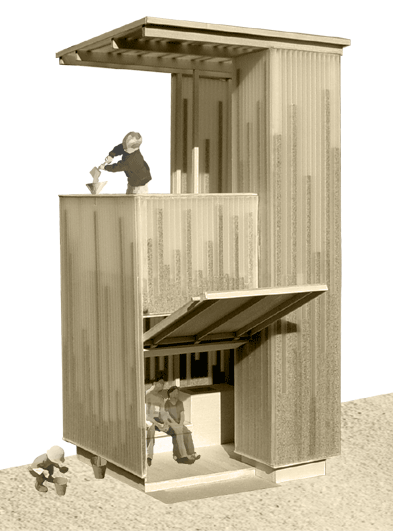
Our office has participated in only one open architecture competition in our four-plus years in business. And although the beach hut competition was fun and inspiring, it was a great example of why competitions are not worth it.

architecture competitions

Our inspiring, but financially draining Sand Hut competition entry.

Since the Sand Hut experience, there have been many opportunities to enter competitions, and of the three Modative partners, I'm often the biggest proponent of entering competitions. Thankfully, my logical business partners are able to convince me not to enter open architecture competitions. They use any number of the following five reasons why open architecture competitions are bad for us:

1.Waste of time and money

An open competition is a project. A project you are going to work on for free. Whether you like it or not, architecture is a business and businesses are in the business of making money, not working for free.

If you're one of the rare architects with idle time, there are plenty of more productive things to do with your time.

2. Projects are almost never built

Every architect knows this. Even the competitions that claim to be for real buildings almost never get built because competition budgets are nonexistent or ignored. The most eye catching and extravagant design wins. The most extravagant design rarely meets budget.

3. Too much competition (You won't win)

Obvious but true. Open competitions have few barriers to entry - it's free-for-all. No matter how good your competition design skills are, you're competing against hundreds or thousands of other architects.

So, for example, if the competition jury reviewed submissions for 8 hours (a generous assumption), and they received 1,000 submissions, that would give them about 28 seconds to look at your project. The same project you just worked on for 100+ hours is getting judged in less than half a minute. You get the point.

4. Provide little publicity, if any.

If you don't get gold, silver or bronze, no one cares. Even if you are recognized in the competition, the publicity will rarely match the effort.

Besides, the world of publicity has changed significantly in the last few years. Hoping to get press through a competition win is an old-school mentality. Nowadays, you can design great stuff then let the world know on the interwebs. If you're really good, and decent at getting the word out, people will find you. You don't need a competition for publicity.

5. They devalue architects

Ooh look, we can get all these silly little architects to work for free. Have you ever seen doctors or lawyers sign up in droves to do free work?

Exhibit A

A few weeks back I received the following open competition email announcement from the American Institute of Architects (AIA). This clearly highlights some of the problems with these types of architecture competitions.
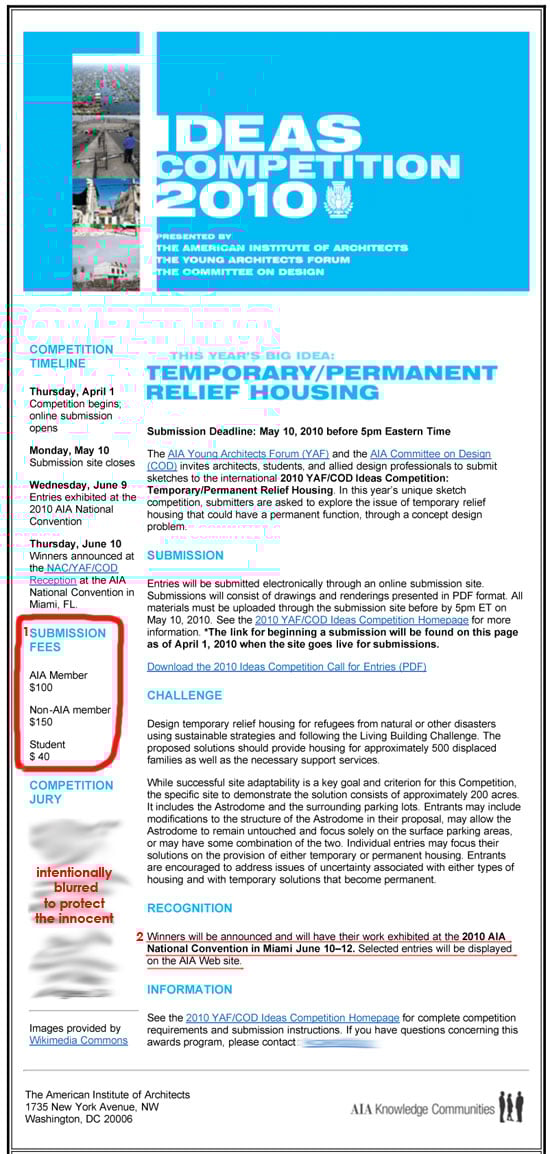
architecture competitions suck
 

Disclaimers: I'm an AIA member, and like anyone that pays a lot of money towards a professional organization, I have the occasional right to gripe. Before everyone gets all cranky, I do realize that this competition is for a good cause. However, there are many other ways for you to use your skills as an architect for a good cause which we'll touch on in a future blog post.

Problem #1: Submission Fees: Not only is this not a competition for a real building, nor do you get money if you win, but you have to pay to enter. Pay them, then work for free. Does anyone else find this crazy?

Problem #2: The Reward: So, if you're lucky enough to win this competition, you get to show other architects your work for a few days at the AIA National Convention in Miami. None of these architects will hire you to build your genius temporary relief housing scheme. Not such a great reward for all this work, huh?


Instead of just complaining about open competitions, we've got some solutions. In a future post, we'll discuss some alternatives to architects wasting time with open competitions. UPDATE: That post now exists - 5 Things Architects Should Do Instead of Entering Open Competitions


Side Note: This post has been sitting in the draft box for several weeks. A few days back, I noticed that a very talented fellow architect blogger, Jody Brown, AIA, LEED AP, posted a very interesting article about architecture competitions on his "Coffee with an Architect" Blog. At first I was hesitant to publish this after seeing his post on the same topic. Who wants to be seen as a topic copycat? But we have very different takes on open competitions. I encourage you to check out his post - Architectural Competitions are a Glorious Waste of Time. He makes some very interesting points that go against most of what I just said. He's pretty convincing.


What are your thoughts on open architecture competitions?

Comments

As a marketing and branding professional I must admit I have always wondered why professional service providers (like architects) would give away their time and talent for no reward.  
 
Shakespeare said "We are advertised by our friends." I suggest that architects and other professional service providers (yes, even doctors and lawyers) are "advertised by their work." 
 
A solid portfolio and good references should be quite sufficient for a firm to make it to a short list for consideration. Then an honest, open conversation with the prospective client should help both sides determine if this is the right "marriage" to realize a successful outcome. 
 
Of course, the insanity of doing free design work will continue until enough people/firms stop the practice (especially the ones that don't need the "practice"). 
 
One final note: when you're young and don't have the portfolio or the references, you may need to work like a dog for little or no recompense except for the beautiful example you get to add to your portfolio to show the world how you think, and what you can create. I'd say that is a fair deal.
Posted @ Tuesday, May 18, 2010 11:33 AM by Tom Miller
You forgot the part where the winner is always politically choosen (or a relative of the jury).
Posted @ Tuesday, May 18, 2010 12:05 PM by Steve Nicholson
I have realized of this problem a long time ago, and therefore our company is working on this to promote a competition that is worth it for upcoming and future architects. Not only will the competition be free, but it will have very strict rules so there is a limit on who applies. This means less amount of competitors; more chances to win. So just to outline the corrections to these outrageous competitions out there, these are the points we will fix in our competitions. 
 
1. Free. 
2. Strict rules on who applies. 
3. Great Awards- Published on websites and known National Magazines + $$ 
4. Be able to attend next important convention for free. 
 
These are just a few points we will be adding to our competitions.  
 
So if you are interested, contact us and add your project to our site. We will be announcing our upcoming Free Competition. 
 
Again, this competition is just target it to future architects/ students. 
 
Posted @ Tuesday, May 18, 2010 1:26 PM by Julian Melo
I think competition time in most cases would be better spent on meeting the other Architect initiative that has been overshadowed lately by the much sexier 2030 challenge, the One Percent challenge for pro-bono services. 
 
Architecture for Humanity, Public Architecture, Architects without Borders, and my pet organization, Engineering Ministries International, all have clients with current and pressing needs for volunteer architects to do some good with real projects around the world. 
 
That said, I think the Haiti competition isn't as bad as, say, "design a house for Lady Gaga". They do need some real solutions down there for housing, and quick.
Posted @ Tuesday, May 18, 2010 1:29 PM by Jay
having been on the placing side of a few european competitions, i have mixed feelings about them. 


in europe, competitions are a fairly standard approach to getting built work (as many winning submissions are built, and not always with political or familial ties). they're also a way for younger firms to make their mark.  


as an intern/unlicensed architect in the states, it has allowed me to work out ideas and build up my portfolio when projects at work have been fairly inadequate. 


also, the few firm competitions i have worked on have been mostly marketing forays. 


we're typically not fans of paying entry fees for competitions, either. 


however, built competitions typically provide a better benefit to the public AND the client.
Posted @ Tuesday, May 18, 2010 8:54 PM by mike
Hi Derek, 


While I agree with every point you've stated in your blog, I do think competitions may be beneficial to those designers and professionals just starting out and those who may be going through a slow period and want to fill time gaps in their resume. Competitions could keep the creative juices flowing and help build a portfolio.
Posted @ Wednesday, May 19, 2010 8:15 AM by Karen A. Davis
Thanks for the comments. 
 
A few things: 
 
1. Europe 
I am definitely writing this from a North American perspective. I am aware that in other parts of the world, especially Europe, competitions are a way of life in the architecture profession and a major source of getting projects. However, most of those competitions are very well organized, and the reward is often a building. I still don't think this is fair to architects, but until we take a stand, the abuse will continue. 
 
2. Students/Youngsters/Portfolio Building 
There are better ways to build a portfolio and to keep creative juices flowing than competitions. Things that will benefit the architect and society. We have a good list going here in our office and it will be the topic of a post in the near future. 
 
3. Pro-Bono Work 
This is one of the things on that list of great alternatives to competitions. 
 
-Derek... 
Posted @ Wednesday, May 19, 2010 11:25 AM by Derek Leavitt
Very interesting post. 
As a young pratice and an ex-employee I think we should mention that competitions are also often an excuse for hiring unpaid interns/employees. I saw this situation a lot : offices that receive CVs just tell young architects/students "I can't pay you but you can work on this competition". So the boss doesn't take any financial risk, and the employee isn't even named...
Posted @ Wednesday, May 19, 2010 1:42 PM by Nicolas
Well boo hoo. 
So you've entered one competition which required you to design a crappy little beach hut. So you didn't win? Don't be such a cry baby. Use the loss as motivation to come up with something better next time!
Posted @ Thursday, May 20, 2010 3:15 AM by Boo-Hoo McCracken
it is my impression that what you say is true, but, only from the business point of view. 
architecture has some other elements also included. 
where is the rest?
Posted @ Thursday, May 20, 2010 7:26 AM by dritan
Competitions are probably not appropriate for firms that approach architecture from a pure business standpoint - ie max profit. But architecture is about more than max profit, and some of the most inventive, creative ideas emerge from competitions. Competitions are just one vehicle we have to foster innovation and new thought in the industry. Whether these ideas end up reflected in actual buildings is less a problem with competitions and more of an issue with how projects are executed in today's market.
Posted @ Thursday, May 20, 2010 2:50 PM by LLny
This is such a strange mentality to me; the idea that creativity can only occur if you are practicing bad business and working for free. Architects should strive to do better. Be creative and savvy business people. 
 
Everyone, including architects, praise Apple for making innovative products. Well, guess what? Apple also makes money when they sell iPhones. Apple competes where competition counts the most: in the real world. 
 
Nowhere in this post do I advocate for architects to stop pushing the limits. Competitions are not necessary for creativity. I would argue that it takes far more creativity to make something innovative happen in the real world, where you compete to get the project, then compete against all the forces at play: budgets, codes, NIMBYism, schedules, etc. 
 
Open competitions are an old school mentality - let someone else organize what I'm going to design and where. Then judge it for me. If this approach feels comfortable to you, that's because it is. It's the same thing you did in architecture school. 
 
I'm not totally against competitions. We're actually working on one right now, (although it's quite different than an open architecture competition). Architects just need to better value their time and efforts before jumping into these open competitors that will have little impact on improving their careers. 
 
-Derek... 
Posted @ Thursday, May 20, 2010 4:36 PM by Derek Leavitt
I agree with most of what you say, and competitions should not be viewed as a ticket to becoming the next big name in architecture - or else you'll keep trying and trying, playing the odds. 
 
Unfortunately most of us spend our days working for firms doing menial projects and not implementing our design skills to the fullest. Is it fair to us? No. Is it right? No. As a young architect, do you want to do something about? Of course. Do you have "the pull" at your level to influence the design direction of your firm? If not, then think about how you will get there; how you will have a client of your own someday, maybe even your own firm. What will you have to show your client about your design approach? Your average project from your average firm? Hopefully not. In that way, a competition entry can fill a void, as a previous commenter mentioned. Do you think you will get international fame and glory from an open competition - don't count on it. Just do the competitions, or make up your own projects for that matter, keep your design juices flowing and build up a portfolio of projects. Granted they will be unbuilt projects at first, but infused with more reality than your school projects back in the day and you can dovetail these projects with your practical work experience. When you reach out to clients, you'll be able to express your design approach, not your boss's design approach.  


Well, that's only my view...there are certainly other ways to do it. Competitions could just be a career phase or a bridge to the next step.
Posted @ Thursday, May 20, 2010 5:58 PM by LLny
LLny, 
 
Thanks for your feedback! 
 
You make some great points. My perspective is clearly that of a firm principal. I get to make decisions as to our firms direction and my role in our projects. 
 
There are many architectural professionals (especially the young) that do get stuck with mundane work that need their own voice. For them and students, my arguments against competitions are less relevant since neither of them are doing it to make a living. 
 
I do, however, have a few alternatives that I think are more productive than these open competitions, but I'll save that for that future post I keep talking about. Time to get writing... 
 
-Derek...
Posted @ Thursday, May 20, 2010 7:34 PM by Derek Leavitt
I agree with you Derek. In my opinion a real architecture competition happens when there are few competitors (for sure less then a dozen competitors). More than this is a lottery. Don't expect the juri to really take the time to understand your idea. Last competition i entered there were 588 competitors and in one single day (i dont know how much hours, for sure no more than 6.., 4 persons plus the president of the jury (almost 80 years old..) had to choose 30 from this 588. How is it possible?
Posted @ Monday, May 24, 2010 3:01 PM by EF
Open competitions don’t so much lessen the value of architecture, as lessen the value of the architect’s time and effort. That being said, why reduce participation to an all or nothing prospect? 
 
The business side of architecture will unlikely ever consider participation in open competitions a viable money making endeavor, as doing so is akin to gambling in a lottery; it’s primarily a chance operation where one’s “luck” is proportional to the effort and resources one puts into it. But this isn’t reason not to participate. 
 
The marketing side of architecture isn’t opposed to open competitions. They are publicity after all, and any publicity that’s not bad, is “good”. Marketers generally consider small investments, for any potential returns (no matter their timing) a good thing. But this isn’t reason to participate at all costs. 
 
The choice to participate can’t be solely driven by the impossibility of direct monetary returns, nor the incessant “burning” of resources while hoping, against odds, that returns will eventually come. The choice must also consider many things commonly under-valued by the architecture profession. One of which would be the value of the creative act (not to the profession, but to the practitioner). Another would be the value of the presence of your “brand” in the collective conscious (not via the competition organizers, but via one’s own conduits for pushing one’s brand). 
 
There’s no reason to be jaded about the issue. For each potential event just choose one way, or the other and go; but go, and don’t look back.
Posted @ Saturday, May 29, 2010 1:36 PM by Gary Moad
Who says you have to pay the registration fee and submit your final work. I usually download the competition information, finish the competition with in the alloted time and then compare my solution with the poor saps who paid. In the end have something for my portfolio with out giving away my ideas. 
 
Another alternative is to create your own competition. Many times I have look at a vacant site and imagine a certain building type being place on that site. Why do you need an official competition to get you started? 
 
Posted @ Friday, June 04, 2010 5:34 AM by Jerome Martin
Regarding competition work I do agree with many of the points you raise, yet disagree with the foundation of your argument that competition work has no merit. There’s not a lot of difference in spending time assembling marketing brochures and soliciting clients for free. On average architectural firm s can spend between 5-10% of their revenues on marketing their firms to bring in new work and have successfully found given the right project competition work does have merit. 


Overall the attitude in your article is a bit of a glass is half full mentality so I thought I would give a few suggestions of how many of the 'A' list firms go about doing successful competition work. 


1. Avoid Competition Sites 
 
Avoid sites like Bustler and Competitions Magazine and do your research via government procurement portals and client solicitations requesting qualifications (otherwise known as real jobs). Case in point the EU has a fantastic central procurement portal advertising public works open for bid (would be nice if the US would follow suit). 


2. Do Your Homework  
 
First do your homework. Secondly do your homework. Thirdly well you get the point. Throughout the world serious clients either public or private often sponsor paid invited limited entry competitions. I've worked in Europe at a highly reputable company and we managed to build a highly marketable cultural portfolio based on paid invited limited entry competitions. 


3. Stack the Odds in Your Favor & Be Selective.  
 
Find two stage competitions where qualifications are requested first and then lead to paid stipends (if you make it through the cattle call it means you’re on the right track). Throughout Europe and gaining popularity in the US clients pay stipends for conceptual work by multiple firms during a selection process (paid invited competitions). 


4. Leverage Your Expertise.  
 
If you are experienced doing school work don't think you can pull off a concert hall (see #3). The shotgun approach is a guaranteed way to fail in the competition world. Nothing replaces expertise no matter how creative you think you may be. For example your firms works seems to be grounded in housing typologies, this is where I would focus your efforts. 


5. Lose the Lottery Dream and Have a Plan.  
 
So many architects have the perception that they are destined to be the next Frank Lloyd Wright and that winning one of these competitions will ‘make’ them. There is no birthright in our industry and nothing will replace a strong body of work. Creativity, a hell of a lot of hard work, and determination is the way forward so sit down and understand your capabilities, goals, strengths, weaknesses and make a plan of how you will accomplish this.  


6. Read Between the Lines.  
 
I’ve worked on many award winning competitions in the past where we picked up on a minute detail in the brief or knew something the rest of the competitors didn’t (this goes back to research). Finding these differentiators often help your entry stand out far beyond the rest. 


7. Understand the Exposure and Marketability.  
 
Typically you can differentiate the serious competitions from the not so serious. Case in point, The Beach Hut Competition? Not sure this one has high profile client written all over it.  


8. Be Your Own Promoter.  
 
I’ve had many a client in the past key into a second place entry they found intriguing who have contacted us to do work for them. Though not a winner it did lead to work, so yes competition work has a value if you can market it. This comes by building an expertise in an area and having the ability to promote it, the best resources architects have to promote work is themselves so use the mouth you’ve been given. 
 
Posted @ Thursday, February 24, 2011 2:53 PM by Euro Trash
Really like the article. Directors need to stop going on the internet looking for competitions. They can't afford to pay us coz the money ran out on competitions. I mean u can't work on 15 competitions in 3years & none is successful then cut our pay & days of working coz u can't sustain the runnings of the firm. Right now i'm sick of competition work, i went for an interview & they asked me which of these projects on my resume got built & my respond was, none. I was not hired & a word of advise was, "every line we draw at this company gets built & we have never entered a competition. A business course should be included in our curriculum of study or we'll remain artist that draw fancy pics.
Posted @ Friday, February 25, 2011 3:50 AM by Tuki
haha.. i found that point #4 and Problem #1 are very funny, yet it's so true. great article Derek! Getting publicity from an open competition is indeed an old time school. website can do it much easier with broader viewer
Posted @ Tuesday, April 19, 2011 1:11 PM by syits
Brilliant post! I'm wondering where did you get all those assumptions? I agree in almost all the points presented since it is really applicable to our architectural industry today. Keep it up!
Posted @ Saturday, July 16, 2011 6:11 PM by school architects
Competitions are not bad, evil or loathsome. 


Competitions allow people to DREAM! ALL people, not just people who get paid to design. Professionals in Architecture need to view people who never made it into their craft and understand that not everyone has ability to sit in a design firm and work 18 hours a day 6 days a week designing for money and glory as a Star-chatect -- that's only about 5 percent of all architects. The rest of us and those who are not DREAM. It is a hobby to some, some of us take the school and then use that in other professions and hobby around on the side. By opening up architect through multiple school paths, more competitions and greater access to all we can create a world that looks well designed instead of everything that looks the same, except for that 1 percent of built work that no one ever sees, except for the 1 percent of people. So we can all create architecture at any level and submit, or we can not have the opportunity through competitions and only let a few elitist star-chatects who spend ruthless hours and obsessive drive to commit to that one percent.
Posted @ Friday, February 10, 2012 5:17 PM by s
I agree with your thoughts and have appreciated your blog. To share the perspective of professionals with the young-and-aspiring such as myself is very gracious of you.  
 
I am a recent graduate and have only been in the field for about 10 months with a firm I am proud to work for, GF55 Partners in New York City. I enter as many competitions as possible with my design partner and friend who graduated with me and works at a different office. We find these great opportunities to craft our own proposals under structured circumstances with program demands and a context. We dream of opening an office (a la Modative) someday. To supplement the technical knowledge we're gaining at work with the ability to flex our own design and collaboration muscles in our free time after work and on weekends is a very fortunate situation. If we were in business already I could not imagine competition entries as a business model. And I believe that is who you are targeting with the outlook you've shared, those who are in business for themselves or are responsible for the workload of a firm. I must say I agree with your perspective, but I also think that these competitions are good opportunities for people like me who appreciate a little direction when trying to supplement their current professional experience with some independent ventures.  
 
Perhaps the next step for us is to make more opportunistic proposals, as per your suggestion in "5 Things Architects Should Do Instead of Entering Open Competitions."  
 
I really appreciate your thoughts and wanted to share my own perspective as well. Cheers fellas, and thank you.
Posted @ Wednesday, May 02, 2012 9:09 AM by Michael
Comments have been closed for this article.