
a modern architecture firm
Loading

a blog about

modern architecture, design, development & modative happenings

blog authors

Derek Leavitt
Christian Navar
Michael Scott


We post, you get an email. That's it.

Your email:

blog voter

Find interesting posts from the past. Vote. Check out our new blog voter.

contact us

browse by tag

call modern architects

blog 

Current Articles | RSS Feed RSS Feed

7 Tips for Starting an Architecture Firm - Tip 01: Be Cheap

 | Submit to Digg digg it | Submit to Reddit reddit | Add to delicious delicious | Submit to StumbleUpon StumbleUpon | Share on Facebook Facebook | Share on Twitter Twitter | Share on LinkedIn LinkedIn 

This post is part of the How to Start an Architecture Firm series.

In February 2006, three guys in their late 20's quit their day jobs and went to work on forming their own architecture firm. The following is tip number one of seven in their start-up strategy.

Tip 01: Be Cheap

architects be cheap

photo credit

How much money do you think it requires to start an architecture firm?

Most people would probably guess in the tens of thousands of dollars or more. This certainly was not the case with Modative. We began with $500 per partner: $500 that was more of a formality to purchase our company stock.

architecture firm start-up costs

So how is this possible?

For starters, our first office wasn't really an office, but Michael's basement in suburban Pasadena, CA. Needless to say, it was rent-free. And although it was a 16-step commute for Michael, Christian and I had long traffic-filled drives from Los Angeles's west side.
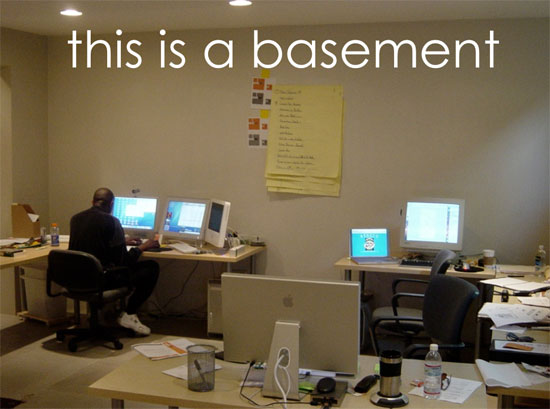
basement architects office

As you can see, we had some decent equipment. But we didn't buy anything except for a few ikea desks, chairs and some minimal office supplies. We used the computers, printers and software we already used personally or could scrounge up from relatives (Thanks Dad).

Our goal was to never spend money we didn't have. Although we had a few (low-limit) company credit cards, we kept expenses light. This was especially critical because we started the firm without any projects or other sources of revenue.

After a few months, Modative's first project came about as an independent consultanting job for a friend's father's architecture firm.
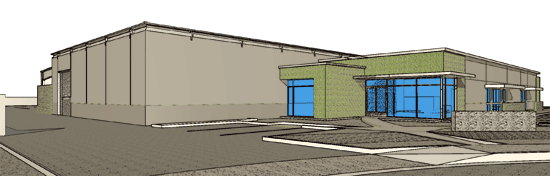
architects first project

The project (above) was a ground-up office and warehouse for a tile manufacturer. It wasn't the most glamorous project, but it was essential to helping us build some momentum as a real business.


One of the other ways we were able to be cheap will be revealed in the forthcoming Tip 02.

Stay tuned over the next several weeks as we fill in the blanks on our 7 Tips for Starting an Architecture Firm.

los angeles modern architecture firm

7 Tips for Starting an Architecture Firm

00 architect firm

00 Bootstrapping

Not a tip, but a critical theme in our start-up adventure.

posted 12.03.09

01 architect firm

01 Be Cheap

posted 12.08.09

02 architect firm

02 DIY - Do It Yourself

posted 12.18.09 

03 architect firm

03 Get Advice

posted 12.22.09
04 architect firm

04 Learn from the Bad

posted 01.22.10  

05 architect firm

05 Start and Stay Small

posted 03.03.10 

06 architect firm

06 ___________________________

07 architect firm

07 ___________________________


Want to stay up to date as we post the 7 Tips to Starting an Architecture Firm?  Subscribe to this blog by adding your email to the subscribe form on the right. We never spam our fine followers and if later on discover you're completely over us, you can easily unsubscribe.


Comments

Does this mean that you charge less?
Posted @ Tuesday, December 08, 2009 12:17 PM by Tim
Congratulations. My observation is that companies starting the way you did are inevitably successful if they don't stray too far from their founding, fundamental principles. Stay true to your mission. And don't let the public acclaim that is sure to follow go to your head.
Posted @ Tuesday, December 08, 2009 1:17 PM by Tom Miller
Tim, 
 
Nice question! Our rates are probably on par with most firms our size. It obviously depends on the size and type of project. But, by being cheap and careful with our spending, we definitely cost less than large firms with huge staffs and fancy offices. 
 
-Derek...
Posted @ Tuesday, December 08, 2009 1:52 PM by Derek Leavitt
Tom, 
 
Thanks for your kind message. Spending has remained low here at Modative due to the current tough market. 
 
We also tend to stay pretty level headed around here. We are also our own toughest critics. 
 
-Derek...
Posted @ Tuesday, December 08, 2009 1:55 PM by Derek Leavitt
Cheap is good, but make sure you explain its not discount service just low overhead passed down to the customer. When I offer services for 5¢ its because im in a plywood booth....it has no roof! hence now overhead ;)
Posted @ Tuesday, December 08, 2009 2:12 PM by John
John, 
 
Totally agree. Our be cheap philosophy is an internal business practice, not a philosophy on fees. Our fees are reasonable, but probably not the cheapest you'd find. Why? Because then we wouldn't be able to provide the proper level of design and service to our clients. Low ball bidding for architecture fees is a total disservice to the architecture industry as a whole. 
 
I admire your 5¢ approach to helping the general public learn what architects do. It's also not a bad way to generate some viable project leads that turn into real projects with real fees. We all know the 5¢ is just to get things rolling. Just like we'll meet potential clients for free to discuss their project before giving them a proposal. 
 
-Derek...
Posted @ Tuesday, December 08, 2009 2:32 PM by Derek Leavitt
My husband and I are the Owner/Principals of our design consulting firm, of which we are also the design strudio, production team, administration, marketing, IT gurus (well, that would be Luke, not me), and we also have a very short commute to our in-home office (previously known as a guest bedroom). Our fees are reasonable and in line with the local design industry (New Orleans region), and we keep our overhead low by having what we call 'virtual' office spaces...our design library is 'online' (we'll order actual samples & literature as a project requires), and our conference/meeting room is generally found at any one of the local Coffee Houses (whichever one our clients prefer), or we'll book a meeting room at our Chamber office if we need to do that for a major presentation.
Posted @ Tuesday, December 08, 2009 4:11 PM by Trisha Spicuzza
Hello and thanks for the series tips, it's already been quite informational for me as a young aspiring architectural designer. My question to you is the same question that is lingering on the minds of many architectural firms at the moment. Especially during a tough economy, how have you been able to find work? My thought is expose yourself to as many community outlets as possible to market the firm and widen the exposure, however how do small upstart firms such as yourself without much of a track record "get in" with institutional type of work? Just include a box of chocolates with every RFP application and cross your fingers. The issue of finding work is something that isn't discussed very often, especially to the young and dumb, so please share your view, I'd appreciate it. 
 
Michael
Posted @ Wednesday, December 09, 2009 1:38 PM by Michael
I agree with your basic cheap philosophy. Regardless of the number of years in business, everyone needs to watch the overhead. In our office of 4 (including my partner/wife) our biggest expense is hardware, software and insurance. We keep our costs low and therefore our fees are reasonable. We renovated an old home in a commercial zone and we live upstairs. When I work out of the area I often meet in hotel lobbies.
Posted @ Wednesday, December 09, 2009 1:54 PM by David Wulff, AIA
Trisha & David, 
 
Thanks for sharing the stories of your architecture firms. I love hearing how other firms work to keep their costs low. 
 
Some of the other topics you've covered in your comments will appear in some of the upcoming tips. 
 
Trisha - We are also lucky enough to have an in-house IT guru - Michael. However, we do use Macs, so IT is kept pretty minimal. 
 
David - Sounds like a cool office configuration. My business partner, Christian, lives above our office as well. A fantastic commute. 
 
Michael - Great question about finding work in today's market. I think I have a nice long answer for you, but it may take me a few days to get it to you.  
 
-Derek...
Posted @ Wednesday, December 09, 2009 7:34 PM by Derek Leavitt
Now you've done it guys... you've attracted one of those fearsome, voracious Indian CAD service providers: me! 
 
I'm sure your business will grow handsomely overtime, recession notwithstanding. At the point where there is more work than your team can handle, do think of sending the overflow to me (my company, that is), and we'll process it for you at rates attainable only as the result of the massive geo-economic forces which are constantly in play. 
 
Take care and good luck --- 
 
Lucky Balaraman 
CEO, TMG 
MS (U Mich), M.ASME, M.ASCE 
 
Find us on Facebook at http://facebook.com/tmgco 
 
Track us on Twitter at http://twitter.com/tmgco 
 
Locate us on LinkedIn at http://www.linkedin.com/in/luckybalaraman
Posted @ Thursday, December 10, 2009 8:09 AM by Lakshman Balaraman
Smaller companies such as this one always produce better results and ideas. It is the smaller companies that make some of the best work and have the best client relations.
Posted @ Friday, December 11, 2009 1:14 PM by Jeremy
I worked out of my Garage years ago and I wish I had that space to work in today! 
Any small projects are good, however many many more clients want more than a bank for the buck! Something i did recently a 2 br apartment.. any fees were eaten up on admin time. 
Posted @ Friday, December 11, 2009 6:22 PM by John
Some more responses: 
 
Lucky - Thanks, but we don't need outsourced CAD. We keep our CAD in-house, which our technology allows us to do. But, maybe some other architects on here do... 
 
Jeremy - Thanks for your comment. Can't argue with it. 
 
John - We're always cautious of that as well. It takes an a lot of admin time to do any project of any scale. Many architects fail to allocate that time and only budget hours for the design and documentation. We track our hours very carefully here, so with each new project we have better and better estimates of what our fee should be based on historical data. 
 
-Derek...
Posted @ Friday, December 11, 2009 7:07 PM by Derek Leavitt
Another couple of things we've done to keep overhead costs down is to minimize the amount of in-house office equipment, either owned or leased (not only saves on costs relative to the equipment, but also floor space). We have an 11x17 deskjet printer in-house, in lieu of owning/leasing a large plotter for larger format drawing sheets. We e-mail our electronic drawing files to a local reproduction company whenever we need a full-size set of 18x24, 24x36, or 30x42 drawings printed out, and the cost of the reproductions is considered a 'reimbursable'. Also, we don't have a large free-standing copier in-house for large sets of specs...we'll go to the local copy retailer, or reproduction company, to use their machines instead...again, cost is considered a 'reimbursable', paid for by our Client.
Posted @ Saturday, December 12, 2009 1:11 PM by Trisha Spicuzza
Great to read about your frugality! I like that term better than cheap, which can reflect poorly on my business. I've been in business for almost two years and this concept is working wonderful for me. I wish like you I had started in my twenties versus my late forties. I view this concept living with in your means. It will nice when our government picks up on this concept. Your a great role model keep up the good work!
Posted @ Monday, December 21, 2009 7:04 AM by Lori
Post Comment
Name
 *
Email
 *
Website (optional)
Comment
 *

Allowed tags: <a> link, <b> bold, <i> italics

Receive email when someone replies.