
a modern architecture firm

modern architecture blog

a blog about modern architecture, design, development + modative happenings
 
Loading

We post, you get an email. That's it.

Your email:

blog authors

contact us

call modern architects

blog voter

Find interesting posts from the past. Vote. Check out our new blog voter.

browse by tag

architecture blog

Current Articles | RSS Feed RSS Feed

7 Tips for Starting an Architecture Firm - Tip 02: DIY


This post is tip number two of seven in our How to Start an Architecture Firm series, a look into Modative's founding in 2006.

Tip 02: DIY (Do It Yourself)

architects do it yourself

photo credit

During our architecture firm start-up, one of the ways were able to be cheap was to do almost everything ourselves. Here are five key things that we did ourselves in order to save money:

1. Filing a Corporation

Lawyers are expensive. And, unfortunately, many people feel they must hire one in order to start a business. This is simply not true.

Setting up a business structure is actually quite easy to do yourself. There are numerous affordable resources to help you avoid hefty legal fees. There's the online legal document service, legal zoomthat can help you set up your firm's business structure for a few hundred dollars. Modative, however, went an even cheaper route and purchased a do-it-yourself book (pictured right) from Nolo at the local book store. The book comes with a CD-ROM that has all of the templates you'll need in MS Word format.

architecture corporation filing

Even if you're not sure which business legal structure is right for you: Corporation, Partnership or LLC, Nolo has books to help you decide. Just remember that every state is a bit different and some states don't permit certain legal structures for architecture firms.

If you have partners, you'll also need to set up a business buyout agreement, also known as a "business prenup".

So now that you know how easy and cheap it is to set up a proper business structure, there are no excuses not to do it. Not going through this simple process is a huge liability, especially in the architecture field.


2. Company Graphics

This is probably a no-brainer for most architects. We are designers after all. Now is your chance to use those non-architecture design skills to help build your business brand with graphics.

Here at Modative, we did, and continue to do all of our own graphics, from business cards to marketing materials. Oh, and yes, we like orange.

Though this process, we also learned that we enjoy doing graphics so much that Modative now offers these services to our clients.


 architects business cards
 

3. Website

modern architects website sample

In line with doing your own graphics, there's never been an easier time to make your own website. We created and maintain our own website without any programming knowledge. Many architects tend to over-complicate their websites with outsourced, fancy flash sites, when a simple do-it-yourself HTML site is easier for potential clients to navigate.


4. Architecture Grunt Work

Anyone with professional experience in the architecture field knows that there's plenty of grunt work to go around. Starting your own firm will place all of this undesirable work at your feet. If you want to keep your firm financially viable at the start, hiring staff should be your last resort.

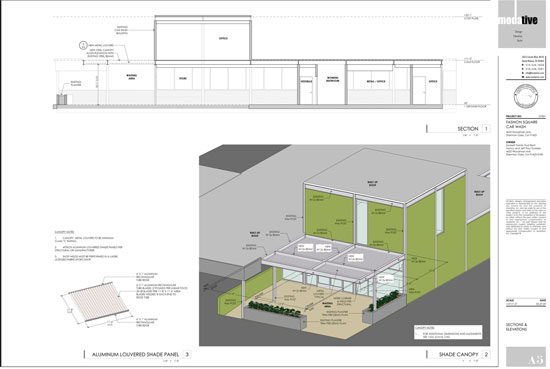
To minimize architecture-related grunt work, we implemented ArchiCADas our CAD software. Since all three partners had used it before and even owned a few copies, it was the logical choice. Besides, BIM (Building Information Modeling) programs such as ArchiCADenable small teams of experienced users to accomplish a lot of work with much less of the grunt work associated with (old technology) 2D CAD programs.
archicad architects BIM

The above example shows how our software enables us to efficiently generate easy-to-read 3D drawings and technical 2D drawings within the same program. This leads to more time for design, less time on grunt work.


5. Office Improvements

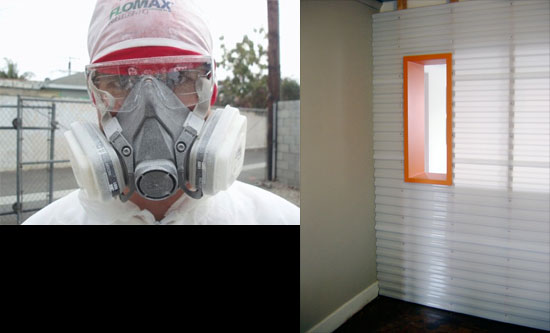
Since our founding office in Michael's basement, we've moved our office several times (more on this in Tip 06). In a few of these moves, we've had to improve less-than-desirable spaces to make them usable for us and presentable to our clients. Without funds to hire a construction crew, we were left to do the labor ourselves.
architects construction

In our third office space, we took a break from architecture to do a little construction and painting. The image above (left) is of me in full gear, ready for some paint spray gun action. Above right is a feature wall that Michael and Christian constructed in that same office.


Although the do-it-yourself approach can be testing at times, it allowed us to acquire new skills and learn from these often rewarding experiences.

Stay tuned over the next several weeks as we fill in the last five tips of our 7 Tips for Starting an Architecture Firm

los angeles modern architecture firm

7 Tips for Starting an Architecture Firm

00 architect firm

00 Bootstrapping

Not a tip, but a critical theme in our start-up adventure.

posted 12.03.09

01 architect firm

01 Be Cheap

posted 12.08.09

02 architect firm

02 DIY (Do It Yourself)

posted 12.18.09 

 
03 architect firm

03 Get Advice

posted 12.22.09

04 architect firm

04 Learn from the Bad

posted 01.22.10  

05 architect firm

05 Start and Stay Small

posted 03.03.10 

06 architect firm

06 Stay Flexible

posted 04.05.10
07 architect firm

07 ___________________________

Want to stay up to date as we post the 7 Tips to Starting an Architecture Firm?  Subscribe to this blog by adding your email to the subscribe form on the right.


Comments

Great job guys. Thanks for sharing.
Posted @ Friday, December 18, 2009 5:06 PM by Enoch
Enjoying your tips, as I'm in the process myself. I have a feeling your next tip - with the lottery balls - is "Get Lucky," with respect to nailing those first clients.
Posted @ Monday, December 21, 2009 11:40 AM by Sandra Carmola
Thanks Sandra, 
 
Good guess, but Tip 3 is not "Get Lucky", however, getting lucky is huge when starting an office. It could easily be one of the tips. 
 
Although luck can often be attributed to hard work, sometimes you just get plain lucky. And we've gotten lucky plenty of times in this journey. 
 
-Derek...
Posted @ Monday, December 21, 2009 12:23 PM by Derek Leavitt
This post brings to mind one of my favorite quotes: "As one goes through life one learns that if you don't paddle your own canoe, you don't move" - Katharine Hepburn
Posted @ Wednesday, December 23, 2009 9:38 AM by Trisha Spicuzza
Trisha, 
 
Great quote. Sums it up well. 
 
-Derek...
Posted @ Thursday, December 24, 2009 11:47 AM by Derek Leavitt
If the basement office seems to be the norm for startups, then why do so many other architects look down on those who work from home? I've been cranking out professional work from my basement for 18 months now and I don't see owning my own office building anywhere in the future.
Posted @ Monday, December 28, 2009 9:56 AM by Rich
The more you can do for yourself initially the better. Eventually you have to learn to delegate and pay others but the best recipe for early success is to make sure you can do each step from programming to CDs to CA yourself. That way you pay yourself.
Posted @ Wednesday, January 06, 2010 2:30 AM by Sean O'Hara
Rich, 
 
I think many architects are obsessed with the idea of having a fancy office for their clients to see. However, this notion may be changing with the current economic climate as many firms downsize or move their offices home. 
 
Sean, 
 
Great point. Doing it yourself at the start also makes you a better leader. As the firm grows, anything you delegate to staff is something you've done yourself as you built the firm. This level of understanding is critical to good management. 
 
-Derek...
Posted @ Wednesday, January 06, 2010 12:03 PM by Derek Leavitt
With respect to your first point in this point about lawyers, not all lawyers are expensive. I am an attorney with large law firm experience but now that I am practicing on my own I offer very affordable flat fee services to my clients, including helping to form a legal business entity. Although it is possible to form a legal business entity without an attorney by filling out the State's form, I highly suggest that one seek the advice of an attorney in order to understand the State's legal requirements for businesses and to at least review the forms that you prepare. As an attorney I do not suggest relying on websites like legal zoom because such websites are not sanctioned by the American Bar Association. You may find that you are not complying with the law by relying on those forms.
Posted @ Wednesday, January 06, 2010 2:46 PM by Priya Marwah Doornbos
Priya, 
 
Your point is well taken, however, affordable legal services is relative. For a start-up with minimal funds it still may not be affordable to hire an attorney, even with "reasonable" flat rates. It certainly isn't $50 (cost of Nolo book) affordable. 
 
What I recommend to corporations that go the DIY route on corporation setup is to hire a lawyer at a later date when they can afford it, to review their corporate documents for compliance. Until the firm is really up and running, generating revenue, and designing projects, liability is minimal anyway. 
 
It also comes as no surprise that the American Bar Association does not sanction DIY websites (like legal zoom) since they obviously reduce the need for attorneys. The same attorneys that fund the ABA.  
 
It would be great to see more attorneys like yourself offering affordable fixed fees for small start-ups. Especially since we both know that the amount of work it takes to file a corporation is very minimal. This strategy will also help you build a good client base of companies that are likely to grow grow and require more extensive legal services. 
 
If you reply to this, please add your legal firm's contact information for any architecture firm start-ups that may want to consider your flat fee services. 
 
Thanks, 
 
-Derek...
Posted @ Thursday, January 07, 2010 12:57 PM by Derek Leavitt
Derek, 
 
Thank you for your response on my comment. I do appreciate the fact that start-ups may not have funds to hire an attorney, and I also appreciate you allowing me to post my contact information for any architecture firms that may need a business attorney. You can contact me at priya@pmdlegal.com and you can find more information about me on Twitter: @PriyaLawyer, on LinkedIn:www.linkedin.com/in/priyamarwahdoornbos and on my website atwww.pmdlegal.com. You can find information about my flat fee services at http://pmdlegal.com/Flat-Fee-Services.html. For a start-up, I offer legal services on a monthly flat fee of $325. That is for unlimited legal advice and services to help you form your entity, draft and review contracts and help with intellectual property matters regardless of the number of hours I actually spend. This monthly fee for unlimited services would equate to 1 hour of my time at my billable rate at a law firm. With a monthly flat fee program, clients do not have to worry about racking up those billable hours every time they call me with questions or advice.  
Posted @ Thursday, January 07, 2010 4:12 PM by Priya Marwah Doornbos
I was glad to see that your small start-up is leveraging advanced technology like ArchiCAD. In our established firm, this is always a battle, since everyone has different preferences, the principals aren't concerned about anything but financial results, and the paradigm when the firm was created is no longer valid. With a fresh start, you seem to have had the freedom to establish progressive processes from the start. Was it difficult to reach a consensus on these issues?
Posted @ Wednesday, January 27, 2010 6:45 PM by Chuck Kottka
Chuck, 
 
For us, the choice to go with ArchiCAD was simple. We had all used it before and saw the value. Having BIM was and is very critical to our firm - allowing us to complete work at all scales with minimal staff. The upfront cost is nothing compared to the added productivity.  
 
Good luck to you in convincing your firms principals to utilize better software. As is often the case, you may have to wait until you launch your own firm to get the software you want. 
 
-Derek...
Posted @ Thursday, January 28, 2010 12:51 AM by Derek Leavitt
Hi Derek, 
This is a great blog. I just discovered it though LinkedIn, as I am starting up my own architecture practice as a sole practitioner. I have a few questions, if you don't mind: 
 
Just out of curiosity, what type of legal entity did you set up,and why? 
 
1) My attorney (a friend) suggested where it's just me to go the sole proprietor route. Incorporating does nothing to protect me personally as a design professional (at least in Arkansas). I'll need professional, as well as general liability insurance, anyway. 
 
2) What software did you use for your website and blog? Didi you have to learn HTML, or did you use a free "drag and drop" application like WIX.com?
Posted @ Wednesday, February 03, 2010 12:43 PM by Denis Dunderdale
Why do you guys prefer archicad, over revit?
Posted @ Wednesday, April 14, 2010 1:41 PM by Gloriana Mejia
Gloriana, 
 
Three reasons: 
 
1. When we started the office, we all had prior ArchiCAD experience. In particular, Michael and I had been using it for 6 years. 
 
2. Revit doesn't work on Mac. We are an all Mac office. 
 
3. I've never used Revit so this may not be fair, but I don't like Revit's tie in to AutoCAD. I think AutoCAD has bogged down the architecture industry for long enough with antiquated 2D software and a PC only push. I could care less about conforming to the so called industry standard. having said that, I'm glad to see that Autodesk is now pushing Revit. Our industry needs to move forward with BIM and not look back. 
 
-Derek... 
 
Posted @ Wednesday, April 14, 2010 2:30 PM by Derek Leavitt
Just in case you're all wondering why only certain questions have answers, I've answered several of these questions via email, primarily for privacy reasons. 
 
-Derek...
Posted @ Wednesday, April 14, 2010 2:34 PM by Derek Leavitt
Post Comment
Name
 *
Email
 *
Website (optional)
Comment
 *

Allowed tags: <a> link, <b> bold, <i> italics