

When we founded Modative we went through a lot of exercises to create a strategic plan for how to organize the business operations of our design firm. Business operations is a subject matter rarely touched on in Architecture School let alone in most design firms. In fact, most firms operate in the same chaotic manner in which an undergraduate architecture student operates when struggling to weave an endless amount of work into a cohesive final project. Bad decisions, unclear goals, and a lack of clear action items inevitability leads to mass consumption of caffeinated drinks, all-nighters, and mismanagement of time and energy. These bad habits, first developed at a young age, are very hard to break and continuously infect most firms’ culture, becoming an endless cycle of mismanaged projects, bad decisions, and bad ideas. All you have to do after interviewing most architects is drive by after hours and see if the lights are still on or call on the weekend and see if someone answers the phone.
At first, you may think this is the sign of a hard-working office, but most likely it is a sign of poor firm culture, bad project management, and burned-out project teams. At Modative, we are all for hard work, and I would be lying if I said we never work extra hours or on weekends, but there are a lot of firms that run their studios like sweat shops. Not because they have to, but because they have no other choice. The continued mismanagement of project operations and lack of prioritizing and internal communication means mass amounts of energy are spent on tasks that may seem urgent at the time, but really are just the result of poor decision making, over-promising to clients, and a clear lack of short and long-term objectives throughout each phase of a project.
“The Clothesline”
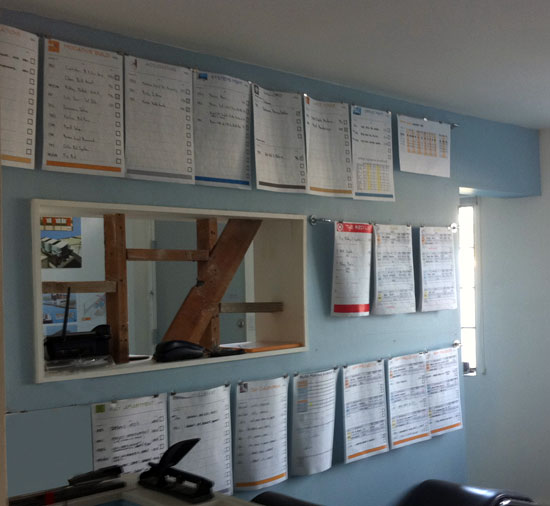
The first book I purchased on my iPad was Making Ideas Happen, by Scott Belsky. After reading about various strategies and concepts regarding methods for implementing ideas and achieving results, I realized it was time to revisit Modative’s strategic plan. It was time for our business operations to evolve into something even better. There is a section in the book that discusses using “progress as a motivational force.” So we modified some concepts found within the book and developed our own strategy to clearly identify action items by “surround[ing] ourselves with progress”. We start every Monday morning by sitting, not in the conference room, but in front of our “clothesline”: a wall made up of a series of horizontal steel cables from which 11X17 sheets of paper are hung from clips, clearly identifying projects, their schedules, and crucial action items that prioritize every project’s goals.
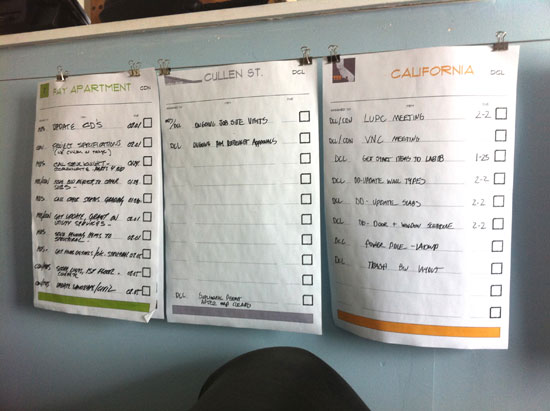 Some of this week's goals
We intentionally didn’t make each project sheet overly complicated. Each page has a project logo, a color, and a title. Each item gets assigned by the project manager to a team member, along with a due-date and a check box to show when each item has been completed. The system allows for very little mis-communication and prioritizes each item so there is never any confusion about what should be worked on when. Our goal at the start of every week is to ensure that we are focusing our energy on things that truly matter that week, will make our projects better, and make our clients even happier. Through “visual organization,” we have been able to develop a system that has become integral to our office’s creative process, keeping us focused and even more engaged then ever before.
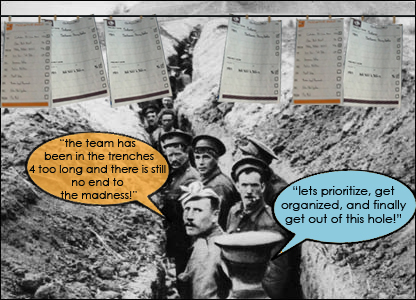
No matter how creative the team, mismanaged office operations lead to the loss of a project’s full potential. A project may seem great in the end, but let’s start thinking about how much better things could have been if a project’s full potential was realized by a team that wasn’t dragged through the trenches along the way. Even award-winning firms suffer from disastrous mismanagement of project operations. Often, long after the AIA award is on the wall, the client and the office are still in recovery mode. The financial ramification brought on by a lack of a clear strategic planning to balance the creative excellence within a firm, can kill morale and ultimately affect everyone’s productivity let alone everyone’s bottom line. In Scott Belsky’s book he explains, “that everything in life is a project, and every project must be broken down into Action Steps...” Well, at Modative, everything really is a project. I’m just glad we are able to rely on our “clothesline” to clearly organize and prioritize our ideas and actions. This way, our clients can be confident that we will inject all of our energy successfully towards reaching their project’s goals.
Being organized allows us ample time to do what we love most: designing and being creative, while still having plenty of time to enjoy life and walk Bella, Modative's office dog.
 |
 |
| Bella- The early years (before lots of walks) |
Bella- after more organization (& after lots of walks) |
Contributors to this post include Krystal Návar, Derek Leavitt and Michael Scott .