Posted by Christian Navar on Tue, Sep 07, 2010 @ 08:15 AM
People often contact Modative about a project they have in mind, but they are often unsure of how to get started. Common questions we receive are:
- How much will it cost?
- What will the city allow us to do?
- How much square footage can I build?
- Is it feasible?
- How many units can I build?
- How much parking do I need to provide?
- What is the process?
- How long will it take to permit or build?
- I have a lot / want to buy a lot / want to lease a property. What can I do with it?
Modative was recently contacted by two individuals who posed many of the questions listed above. The first individual was a long-time business owner with a hard-to-lease commercial auto body shop in Los Angeles. The second was a young entrepreneur looking to find a property in order to open a new restaurant/bar concept. With both of these clients, their long term plans were contingent upon taking really important first steps to decide what to do with the property they own/lease/were looking to purchase or lease.

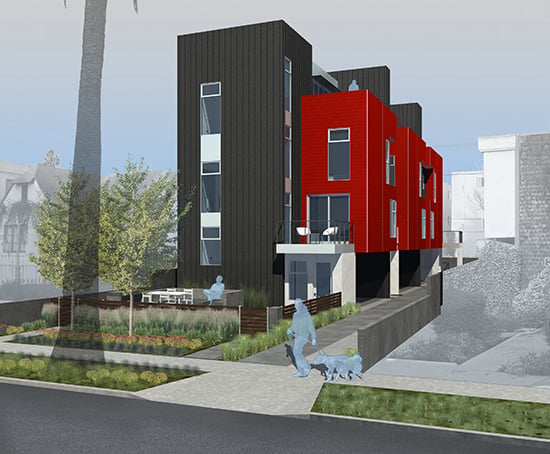
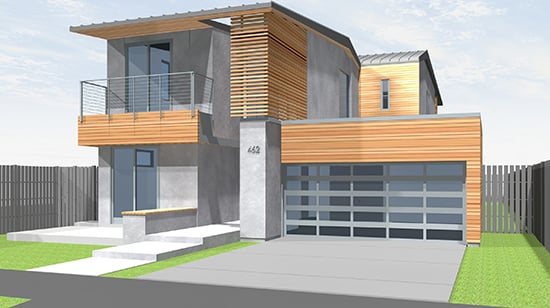
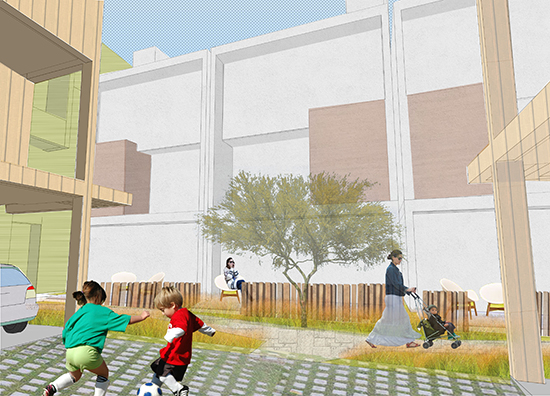
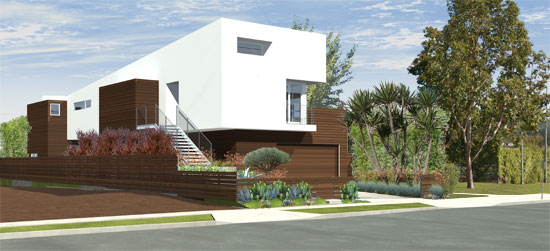
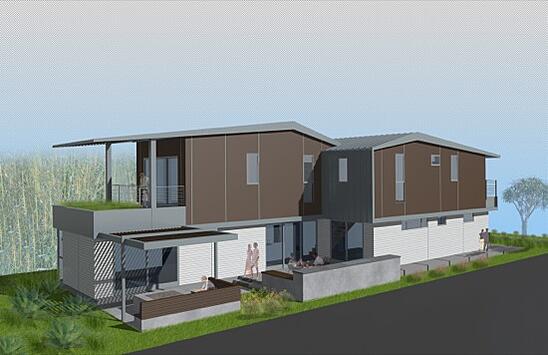
Our services often include conceptual renderings like this one for the aforementioned restaurant/bar in Los Angeles. These renderings are valuable tools for our clients (and their investors) to envision the project's possibilities.
Since the economic climate has shifted downward so dramatically, more and more of our clients are requesting that we provide answers to important questions in order to guide them in the decision-making process before they spend too much of their cash reserves. In our ongoing efforts to give people insight into the helpful services we provide here at Modative, we’d like to share a service in which several of our recent clients have had a particular interest: Site Evaluation and Planning Services.
The beauty of our Site Evaluation and Planning Services is that within a few weeks, for a smaller financial commitment, we can provide valuable insight into what can be done with a property. The level of detail provided in our analysis is catered to the clients specific needs. Some just want the basics, like of what uses are allowed and the code restraints, while others want a more detailed investigation, like program development, preliminary layouts, conceptual renderings, and even preliminary budget analysis of construction and soft costs (architectural, consultants and city fees).

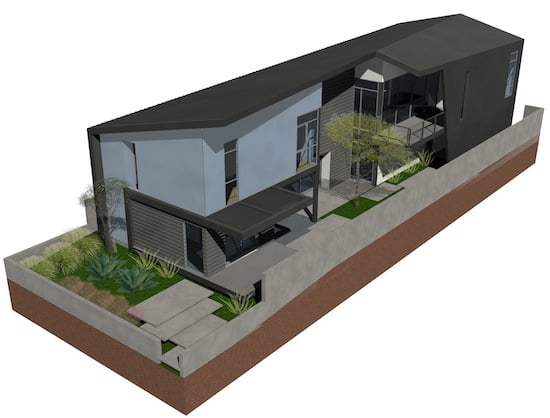
A descriptive 3D Plan we provided as part of the Site Evaluation and Planning Services for an auto body shop conversion into office commercial.
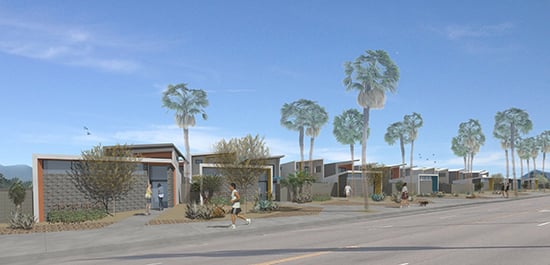
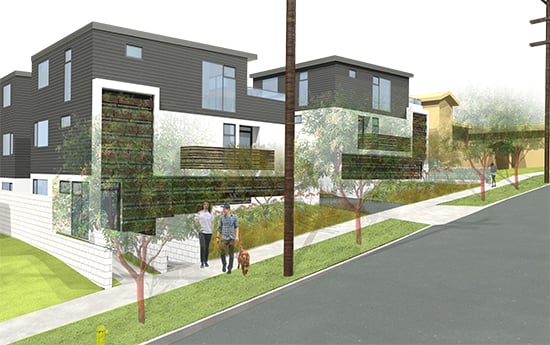
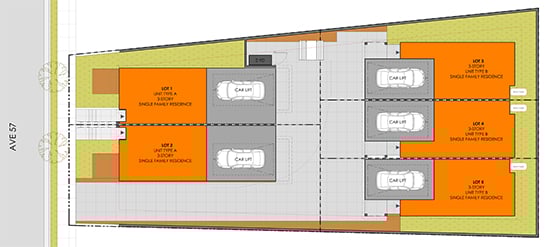
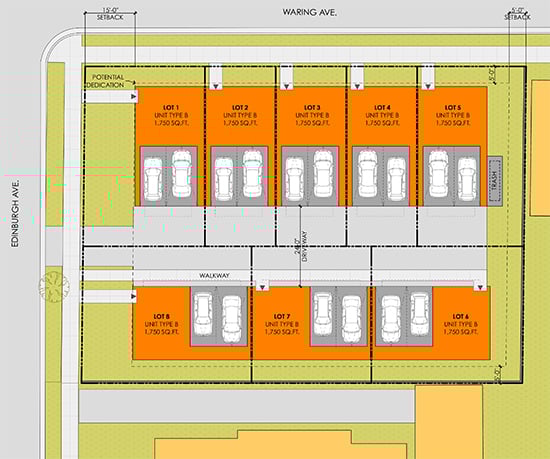
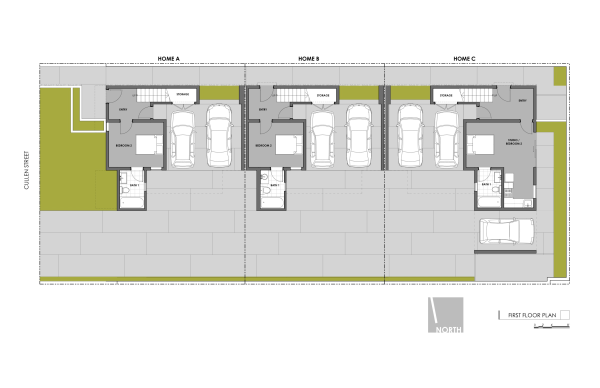
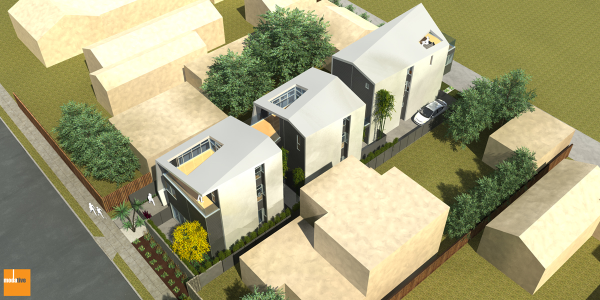
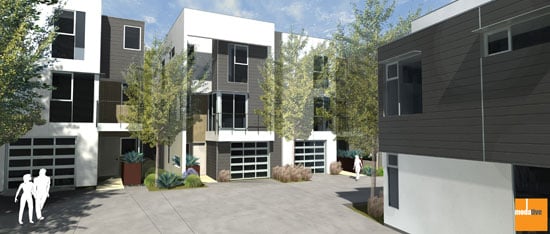
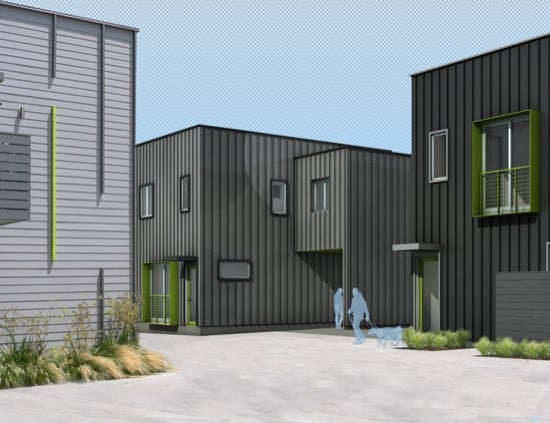
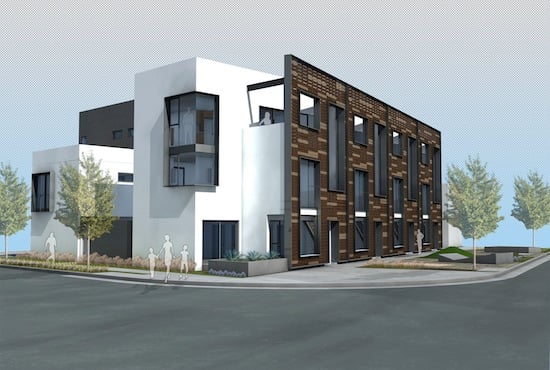
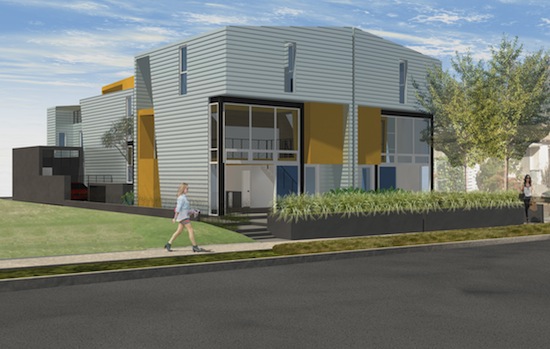
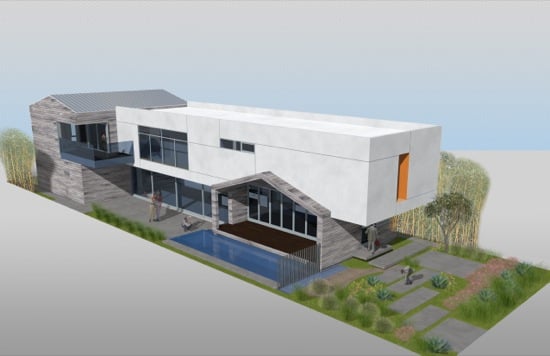
While we frequently provide these services for ground-up projects such as Residential
Small Lot Subdivision projects, we also do quite a few for residential and commercial rehab and remodel projects.
Check out our Site Evaluation and Planning Services page to download a sample report we developed for a commercial rehab project and learn more about how these services are a great way to get a project started without a huge upfront commitment.
Download a sample Site Evaluation and Planning report:
|
A sample case study of a commercial rehab and former auto body shop in North Hollywood, California.
|
Contributors to this post include Derek Leavitt, AIA, Michael Scott and Krystal Návar.
Posted by Derek Leavitt on Tue, Jul 27, 2010 @ 09:31 AM
To us here at Modative, modern architecture is really more about a way of thinking than a style. It's about doing things better, even if it means abandoning old traditional rules. We carry this same critical thinking into the occasional graphic design assignment. An example of this recently occurred with our business cards.
Architect's Business Cards
Four years after our initial order, a few of us were running low on business cards. The natural architect instinct is to redesign the entire card; however, since we're still happy with our logo and look, we decided on only a few minor modifications. Subtracting instead of adding - much like we would do in a building design - eliminating the unnecessary.

No changes to the back of our business card. We like the bold simplicity and abundance of orange that screams "pull this business card out of the jar for the random prize drawing".

The front of our old business cards.
The first subtraction was an easy call: nixing the fax number. Honestly, we don't want faxes. We've contemplated eliminating our fax machine altogether. Anything that can be faxed can be scanned and emailed.
We also considered removing our physical address. The physical address on our business cards has actually been the cause of confusion over the years because it listed our mailing address, not our office location. When we originally designed the cards, we did this intentionally, because we knew we'd move our office a few times in those early years. And we did.
Unfortunately, more than one person has shown up at our mailbox for a meeting. Since we don't want two addresses on the card (too much clutter), we narrowed it down to three options:
- Keep the mailing address
- No address, but have "Los Angeles" to give people a sense of our location
- Go with no address or city and rely on people going to our website to find our two addresses.
Variations of the "Los Angeles" Option. We didn't like the way "Los Angeles" looked on the card. It was as if we forgot the rest of the address.
In the end we decided on Option 3: no address. People have much better access to the web than they did even four years ago when we first printed business cards and our website clearly provides both our office location and mailing address.

The new ultra simple business card sans fax and address.
Integrating Graphic Design and Architecture
We enjoy graphic design, especially when it's integrated into the architecture, like the graphics work we did as part of the Fashion Square Car Wash remodel.

New sign graphics designed by Modative.

The old sign

Simplifying the signs at the welcome canopy.

The old cluttered welcome canopy.
For the Fashion Square Car Wash, we designed all of the signs and graphics, including business cards, coupons and staff shirts.
We've found that providing our clients with graphic design as part of our beyond architecture services provides for a strong consistency between the graphics and architecture, making for a successful project.
Contributors to this post include Christian Návar, Michael Scott and Krystal Návar.
Posted by Derek Leavitt on Thu, Jun 10, 2010 @ 04:52 PM
If you've been following along with us here over the last few weeks, you've surely noticed that we've been bashing open architecture competitions and even suggesting alternatives to these time wasters.
So you may find it a bit hypocritical that today I'm announcing that we won a competition. That is, until you note the following differences between this competition and a typical open architecture competition.
Not Just an Architecture Competition
The competition we entered was through the Urban Land Institute (ULI) to develop housing for the chronically homeless. As I posted back in April, it was a team development competition consisting of other young real estate and social work professionals. Architecture was only a piece of the proposal. Our team had to find a property, create a program, design a project, determine the services offered, and develop a detailed pro forma of how the project would be financed. The process simulated a real project compressed into six weeks.
The site we selected in Glendale.
The Competition Wasn't Open
Our team had to apply in order to get accepted to participate. There were only five teams competing.

We even got to make our own cool logo. We were called Team HETED (Homeless Empowerment Through Efficient Development)
Collaboration
Each team was assigned a city to work with in Los Angeles County: Pasadena, Whittier, East Dominguez Hills, Long Beach and our sponsor city, Glendale. We also worked closely with homeless non-profit advocates and developers, Path Achieve Glendale
and Path Ventures. The city and these organizations acted like our clients. By working with them we got to make real connections. Connections that could lead to future work.

The project concept is a hybrid of preservation of 1920's bungalows and modern intervention of adding new elements to bring the project up to code and provide services for the residents.
Team Aspect
Our team really enjoyed working with each other on this. I think we will collaborate again on future projects.
Exposure
The Urban Land Institute is a diverse organization. It reaches all types of real estate professionals. We prefer this type of exposure over showcasing our work to a bunch of fellow architects.
Pro Bono
This competition was our launch into pro bono work. We spent 130 hours working on this competition. This gives us a real gauge as to the level of commitment required to do future pro bono projects. We already have an idea for our next pro bono project. It won't be through a competition.
Overall view of the project
Whether or not you buy our arguments for entering this competition, I encourage you to check out our winning proposal. You can also view our online press release.
What do you think of our proposal?
Posted by Derek Leavitt on Mon, Apr 05, 2010 @ 10:10 AM
This post is part of the How to Start an Architecture Firm series.
In February 2006, Christian, Michael and I went to work on forming our own architecture firm. The following is tip number six of seven in our start-up strategy.
Tip 06: Stay Flexible
photo credit
Starting your own architecture firm is not a settling experience. It's not glamorous.
There are many implications to being a flexible company, but I'm going to focus on our flexibility with regard to physically moving our office.
Office 01
As mentioned back in Tip 01, we started our firm in Michael's basement. We didn't have money for fancy furniture. We could only afford IKEA. This turned out to be a blessing.
Our IKEA desks are simple. The $20 laminate table top is sold separate from the $4 metal legs. After a few minutes mounting the leg brackets with a drill, the legs screw right into the table top. Equally important, the legs unscrew, without tools, in about 30 seconds. A genius design, especially considering that we moved into our fourth office space by the time our company was 40 months old.

IKEA Vika Amon table top and Vika Curry legs
Office 02
After a few months in Michael's basement doing start-up stuff and completing our first few jobs, we had enough money for a real office. Well, not a real office, but a small office suite in a tower by the airport. The conference room was shared with other businesses on our floor. Our office suite looked right out on the 405 freeway (see picture 02 below).

Our four offices in 40 months overlaid on a map of Los Angeles.
Office 03
Our third office space, as touched upon in Tip 02, was a converted old house located on a commercial property. The property was the future site of a project we were designing, the Venice Boulevard Urban Dwellings. We worked out free rent as part of our design fee.
Office 04
When that project was put on hold as a result of the housing market collapse, we had to move next door into a commercial building. Rent wasn't free anymore. The space required some upgrading, but nothing like what we went through with the old house. We're still here and it's working well for us.
One way we maintained consistency was to get a mailbox in our first month of operation. We opted for a UPS mailbox near where I live. We still have the mailbox, which is a small price to pay for staying flexible. One less obstacle to moving the office quickly.
While I never expected to be moving so much, we always had a positive mindset. Each move was not only a physical upgrade, but an opportunity to rethink our internal organization. Keeping things fresh.
Stay tuned as we fill in the final tip of our 7 Tips for Starting an Architecture Firm.
|
|
7 Tips for Starting an Architecture Firm
|
 |
Not a tip, but a critical theme in our start-up adventure. posted 12.03.09
|
 |
posted 12.08.09
|
|
posted 12.18.09
|
|
posted 12.22.09
|
|
04 Learn from the Badposted 01.22.10
|
|
posted 03.03.10
|
|
06 Stay Flexibleposted 04.05.10
|
|
07 ___________________________
|
Want to stay up to date as we post the 7 Tips to Starting an Architecture Firm? Subscribe to this blog by adding your email to the subscribe form.
Posted by Derek Leavitt on Fri, Jan 22, 2010 @ 08:15 AM
This post is part of the How to Start an Architecture Firm series.
In February 2006, the three of us went to work on forming our own architecture firm. The following is tip number four of seven in our start-up strategy.
Tip 04: Learn From The Bad

photo credit
As every aspiring architect leaves school, they are faced with an important decision, "Where should I work?" This is a tough decision. Go work for a big corporate firm and risk getting stuck on one project for several years or go for a small design-oriented firm and miss out on some of the business savvy of a larger firm?
Although this is an obvious over-simplification of architecture firm types, many young professionals fret over this decision.
When I graduated from USC, Michael (fellow Modative partner) and I went to work for a medium-sized (8-15 people) sized firm in Santa Monica, CA called David Jay Flood Architect. My experience at this firm was invaluable. I was given a high level of responsibility managing large projects at a young age. I did a lot of learning on the job.
After three years at that firm, I moved on, working for two more firms before founding Modative with Michael and Christian in 2006. In my time working for other people I learned plenty of good architecture industry practices, but I also learned a lot of what not to do. I call this "learning from the bad."
So while my experience involved working for small- and medium-sized firms, I've come to realize that the type of firm(s) you work for is less relevant than what you gain from the experience. Learning from the bad is a big part of this. Learning what to do and what not to do are inextricably tied. If you never give yourself the opportunity to learn what not to do by watching other people work, you're more likely to make those mistakes when you're running your own firm
Whether you don't like the way your boss manages projects or you made a big mistake on a set of plans, you will no doubt encounter plenty of negative situations working for others. These bad experiences are invaluable when you decide to start your own firm. File them away for when you're the boss and have to decide how to run your firm.
So, when the time comes to start your firm, will you make the same mistakes or will you learn from the bad?
Stay tuned over the next several weeks as we fill in the last three tips of our
7 Tips for Starting an Architecture Firm.
|
|
7 Tips for Starting an Architecture Firm
|
 |
Not a tip, but a critical theme in our start-up adventure. posted 12.03.09
|
 |
posted 12.08.09
|
|
posted 12.18.09
|
|
posted 12.22.09
|
|
04 Learn from the Badposted 01.22.10
|
|
posted 03.03.10
|
|
posted 04.05.10
|
|
07 ___________________________
|
Want to stay up to date as we post the 7 Tips to Starting an Architecture Firm? Subscribe to this blog by adding your email to the subscribe form on the right.
Posted by Derek Leavitt on Tue, Dec 22, 2009 @ 10:59 AM
This post is part of the How to Start an Architecture Firm series.
In February 2006, the three of us went to work on forming our own architecture firm. The following is tip number three of seven in our start-up strategy.
Tip 03: Get Advice
photo credit
After nearly four years in business, I can say with great certainty that we wouldn't have survived more than a year without getting great advice from some key people.
Asking for advice is easy. People love to give advice and share their success stories.
Our advice came from the following four groups:
1. Family
Aside from getting your family on board with the idea of you going out on your own, you should also get their advice. There's a good chance that at least one person in your family has started their own business.
2. Friends
While we received great business advice from many of our friends, there are two in particular that stand out:
Sam Sam is an entrepreneur. The three of us went to USC with Sam. And while we were drawing and building models over in architecture school, Sam was in business school learning to be an entrepreneur. Actually, Sam had always been an entrepreneur. It's in his blood. There's a rumor that as a child, he outsourced his chores to other kids in the neighborhood, maintaining a cut for himself. When his Mom found out, she was too proud to punish him.
| Sam will likely kill me for profiling him on our blog.
|
By the time we formed Modative, Sam was on his third business start-up. He advised us to be cheap (see Tip 01) and to do much of the start-up work ourselves (see Tip 02), such as forming our own corporation. Sam also got us started on internet advertising years before the bulk of the architecture industry caught on.
The fact that Sam is not an architect was actually an asset. He taught us to question norms within the industry. Sam continues to push us today.
Jon Jon is another good friend from USC. Jon is a lawyer. He lives in Northern California. While in Tip 02: DIY, I recommended to avoid hiring a lawyer, as our business grew, we found ourselves needing legal advice on contracts and other minor items. Instead of hiring an attorney, we've asked Jon for advice. In return for his help, he always has a place to stay when he frequently visits Los Angeles. And when the time comes for Jon to build his own house, he'll cash in all those favors. If you'd like Jon to be your lawyer, he can be found here - Tingley Piontkowski LLP
Jon will probably also be less than pleased that I've profiled him on our blog. Now we'll need a new lawyer friend to defend us in a lawsuit from our first lawyer friend. |
|
3. Network
Guessing and gut instinct are not good business strategies. Finding an expert or someone who's been there before will dramatically increase your rate of success. Beyond your family and close friends, there's a network of people that can help you with just about anything.
Need advice on web design? Chances are you know, or your friends know, someone that is a master web designer.
4. Competitors
Overall, I would say that the architecture industry is pretty amicable. Advice flows freely. We used this to our advantage early on, meeting with established architects that would later become our competitors. The idea was not to steal from them, but to learn from them.
Since then, we've met with numerous younger professionals trying to start their own firms. We share with them (and now you) like other firms shared with us, knowing full well that they might become our competitors in the future. A full circle of idea sharing.
Stay tuned over the next several weeks as we fill in the last four tips of our 7 Tips for Starting an Architecture Firm.
|
| 7 Tips for Starting an Architecture Firm |
 | Not a tip, but a critical theme in our start-up adventure. posted 12.03.09
|
 | posted 12.08.09
|
| posted 12.18.09
|
| 03 Get Adviceposted 12.22.09
|
| posted 01.22.10 |
|
posted 03.03.10
|
| 06 ___________________________ |
| 07 ___________________________ |
Want to stay up to date as we post the 7 Tips to Starting an Architecture Firm? Subscribe to this blog by adding your email to the subscribe form on the right.
Posted by Derek Leavitt on Fri, Dec 18, 2009 @ 11:06 AM
This post is tip number two of seven in our How to Start an Architecture Firm series, a look into Modative's founding in 2006.
Tip 02: DIY (Do It Yourself)
photo credit
During our architecture firm start-up, one of the ways were able to be cheap was to do almost everything ourselves. Here are five key things that we did ourselves in order to save money:
1. Filing a CorporationLawyers are expensive. And, unfortunately, many people feel they must hire one in order to start a business. This is simply not true. Setting up a business structure is actually quite easy to do yourself. There are numerous affordable resources to help you avoid hefty legal fees. There's the online legal document service, legal zoomthat can help you set up your firm's business structure for a few hundred dollars. Modative, however, went an even cheaper route and purchased a do-it-yourself book (pictured right) from Nolo at the local book store. The book comes with a CD-ROM that has all of the templates you'll need in MS Word format. | 
|
Even if you're not sure which business legal structure is right for you: Corporation, Partnership or LLC, Nolo has books to help you decide. Just remember that every state is a bit different and some states don't permit certain legal structures for architecture firms.
If you have partners, you'll also need to set up a business buyout agreement, also known as a "business prenup".
So now that you know how easy and cheap it is to set up a proper business structure, there are no excuses not to do it. Not going through this simple process is a huge liability, especially in the architecture field.
2. Company GraphicsThis is probably a no-brainer for most architects. We are designers after all. Now is your chance to use those non-architecture design skills to help build your business brand with graphics. Here at Modative, we did, and continue to do all of our own graphics, from business cards to marketing materials. Oh, and yes, we like orange. Though this process, we also learned that we enjoy doing graphics so much that Modative now offers these services to our clients. |  |
3. Website
In line with doing your own graphics, there's never been an easier time to make your own website. We created and maintain our own website without any programming knowledge. Many architects tend to over-complicate their websites with outsourced, fancy flash sites, when a simple do-it-yourself HTML site is easier for potential clients to navigate.
4. Architecture Grunt Work
Anyone with professional experience in the architecture field knows that there's plenty of grunt work to go around. Starting your own firm will place all of this undesirable work at your feet. If you want to keep your firm financially viable at the start, hiring staff should be your last resort.
To minimize architecture-related grunt work, we implemented ArchiCADas our CAD software. Since all three partners had used it before and even owned a few copies, it was the logical choice. Besides, BIM (Building Information Modeling) programs such as ArchiCADenable small teams of experienced users to accomplish a lot of work with much less of the grunt work associated with (old technology) 2D CAD programs.
The above example shows how our software enables us to efficiently generate easy-to-read 3D drawings and technical 2D drawings within the same program. This leads to more time for design, less time on grunt work.
5. Office Improvements
Since our founding office in Michael's basement, we've moved our office several times (more on this in Tip 06). In a few of these moves, we've had to improve less-than-desirable spaces to make them usable for us and presentable to our clients. Without funds to hire a construction crew, we were left to do the labor ourselves.
In our third office space, we took a break from architecture to do a little construction and painting. The image above (left) is of me in full gear, ready for some paint spray gun action. Above right is a feature wall that Michael and Christian constructed in that same office.
Although the do-it-yourself approach can be testing at times, it allowed us to acquire new skills and learn from these often rewarding experiences.
Stay tuned over the next several weeks as we fill in the last five tips of our 7 Tips for Starting an Architecture Firm.
|
| 7 Tips for Starting an Architecture Firm |
 | Not a tip, but a critical theme in our start-up adventure. posted 12.03.09
|
 | posted 12.08.09
|
| 02 DIY (Do It Yourself)posted 12.18.09
|
| posted 12.22.09
|
|
posted 01.22.10 |
|
posted 03.03.10
|
|
posted 04.05.10 |
| 07 ___________________________ |
Want to stay up to date as we post the 7 Tips to Starting an Architecture Firm? Subscribe to this blog by adding your email to the subscribe form on the right.
Posted by Derek Leavitt on Tue, Dec 08, 2009 @ 11:19 AM
This post is part of the How to Start an Architecture Firm series.
In February 2006, three guys in their late 20's quit their day jobs and went to work on forming their own architecture firm. The following is tip number one of seven in their start-up strategy.
Tip 01: Be Cheap

photo credit
How much money do you think it requires to start an architecture firm?
Most people would probably guess in the tens of thousands of dollars or more. This certainly was not the case with Modative. We began with $500 per partner: $500 that was more of a formality to purchase our company stock.

So how is this possible?
For starters, our first office wasn't really an office, but Michael's basement in suburban Pasadena, CA. Needless to say, it was rent-free. And although it was a 16-step commute for Michael, Christian and I had long traffic-filled drives from Los Angeles's west side.
As you can see, we had some decent equipment. But we didn't buy anything except for a few ikea desks, chairs and some minimal office supplies. We used the computers, printers and software we already used personally or could scrounge up from relatives (Thanks Dad).
Our goal was to never spend money we didn't have. Although we had a few (low-limit) company credit cards, we kept expenses light. This was especially critical because we started the firm without any projects or other sources of revenue.
After a few months, Modative's first project came about as an independent consultanting job for a friend's father's architecture firm.
The project (above) was a ground-up office and warehouse for a tile manufacturer. It wasn't the most glamorous project, but it was essential to helping us build some momentum as a real business.
One of the other ways we were able to be cheap will be revealed in the forthcoming Tip 02.
Stay tuned over the next several weeks as we fill in the blanks on our 7 Tips for Starting an Architecture Firm.
Want to stay up to date as we post the 7 Tips to Starting an Architecture Firm? Subscribe to this blog by adding your email to the subscribe form on the right. We never spam our fine followers and if later on discover you're completely over us, you can easily unsubscribe.
Posted by Derek Leavitt on Wed, Jun 03, 2009 @ 08:28 AM
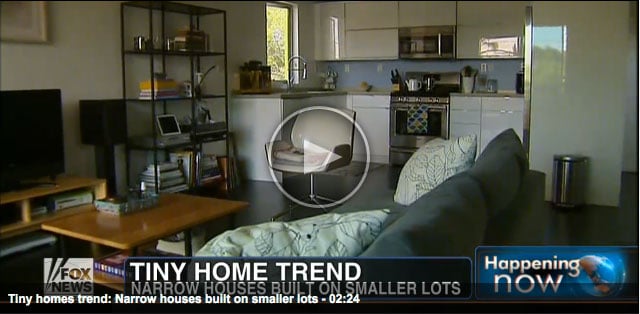
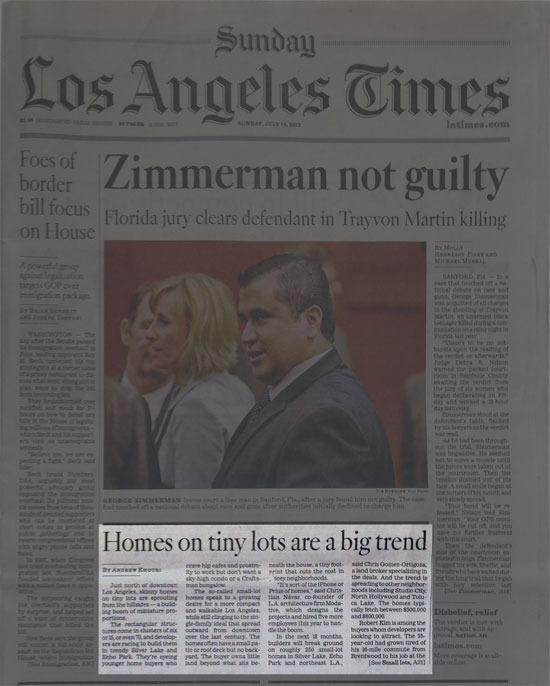
In the spirit of the recent Los Angeles Times article discussing the downsizing of the average American home from 2,629 square feet (last year) to 2,419 square feet (this year), I thought I’d touch on my reasons for liking small homes:
1. Simple Math: If You Build Less, It Costs Less
Tight lending means that loans for big, expensive homes are difficult, if not impossible to come by. Every square foot you build costs more in construction materials, labor, permits, city fees, and dare I say it, architecture fees.
2. Resale Value
What? The Realtor rule has seemingly always been, that the larger the home, the better the value. But things have changed.
Building more can now price you out of the market.
Instead, try building only what you need, not what you perceive some mysterious future buyer will need.
3. Quality Over Quantity
About 10 years ago, Sarah Susanka introduced an idea to build better, not bigger, homes in her popular book,
The Not So Big House.
Her philosophy is relevant today as the economic shift has lessened the appetite for McMansions in favor of more compact, better built homes - the type of home that you'll want to live in for a long time.
4. Energy Efficiency
Aside from the energy you'll save in construction, a small home is far more efficient over its' life span. The mechanical systems needed to heat and cool your home will cost less upfront and will have to work less to keep you comfortable inside.
5. Think About Trading Space For Power
At a construction cost of $250 per square foot, if you were to build just 80 less square feet, you would have the $20,000 it takes to add a very decent solar power system. And in most places, government rebates will help put a big dent in that $20k price tag.
6. Sustainability
This is a much broader topic that is tough to summarize in a quick list; so simply put, small homes use less resources.
7. Affordable Land
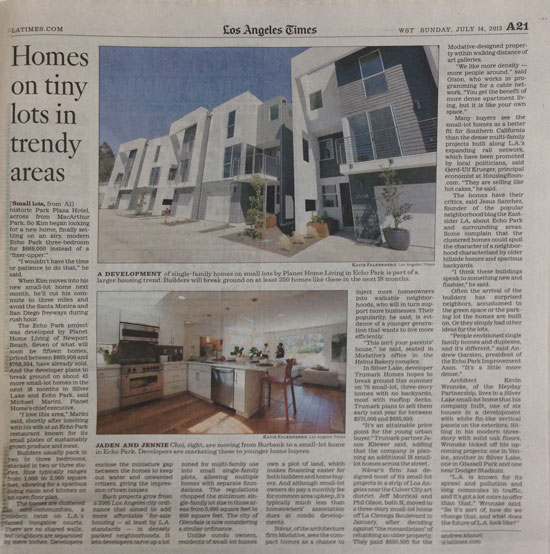
Like many major metropolitan areas, in my home town of Los Angeles, the difficult challenge of finding affordable property makes it tough for many to make that first key step towards building a new home. If you're willing to go small, new opportunities present themselves in the form of more affordable undersized and odd lots that others may ignore.
8. Subdivide
You can also consider becoming a micro-developer by subdividing a larger lot and building a few homes: one for you and the others to sell to help pay for yours.
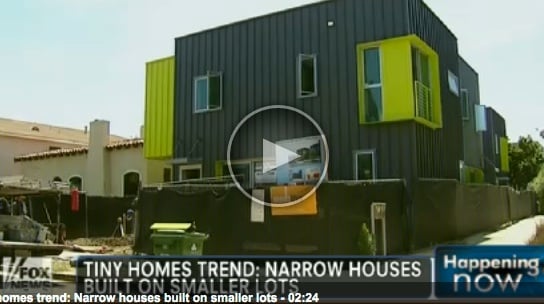
Small Lot Subdivision, which we have here in Los Angeles, is spreading as
other municipalities realize its potential.
9. Keeping It Clean
A simple concept: small homes are easier and faster to clean. If you hire someone to clean, it will cost you less.
It's also not much fun cleaning rooms you never use.
10. Don't Forget the Furniture
Larger home = more furniture you have to buy.
Nice furniture = expensive.
Small home = less furniture needed = can afford better furniture.
11. Less Room For Junk
Quick Quiz
If I had less space in my house to store
(fill in the blank), I would:
a) Pull it out of the closet and put it on display
b) Use it more often
c) Give it away to charity
d) Sell it on
ebay or
craigslistThe correct answer is that these are all good answers.
I love storage as much as anyone, but having too much can have some disadvantages as well.
12. You Can Always Add-On Later
Build what you can afford (& need) now. Plan for what you want later.
By no means is this a complete list. I would love to get some thoughts on this.
What spaces in your house do you not use?
What areas of your home do you wish were bigger? Smaller?
At Modative, we're fans of small modern homes. We like designing them, even on tight budgets. Feel free to contact us if you're thinking about a small home. We can even help you find property.
Download a PDF of 12 Incredibly Obvious Things I Like About Small Homes
Posted by Derek Leavitt on Wed, Mar 04, 2009 @ 12:19 PM
From news reports to personal experiences, we are all now very aware that the real estate world has cooled dramatically, however, the dip in property price and increase in foreclosures has brought about a new round of opportunity. Those who are willing and able to gobble up these affordable properties are in a good position to reap the benefits in the long run. Unfortunately, however, in the last few years, we've seen plenty of mistakes in buying property that could have been avoided with a bit of help from an architect.
Utilize an Architect's Experience
People often falsely assume that they must own a property before contacting an architect. This can be a difficult error to overcome. Architects have experience in understanding zoning codes that affect the value and buildability of the property.
But My Broker Told Me...
There are many great real estate brokers out there, but there are also many not so good. Remember that a broker's end goal is to sell you a property and collect a commission. This often leads to giving you the most favorable view of a property in hopes that you'll close the deal quick and easy. Most brokers will do a very superficial code search on a property, but the problem is that zoning codes are not always so simple, nor are they the only factor in determining the development value of a property.
Beyond the Codes
Although a thorough zoning code check is an important first step, architects have experience beyond just an understanding of the codes. They can typically give you a quick idea of what the site will allow based on other factors or costs.
To give you a better feel of some potential pitfalls, let's look at a few examples that we've experienced:
Client Scenario A - Parking Counts
A few years back we had a young client named Greg come to us with a property in Los Angeles that was zoned RD2 (a multi-family zone). Greg had already purchased this property under the assumption from his real estate agent that he could develop a four-unit condominium on the property.
In theory this was correct. The RD2 zone allowed a density of one unit for every 2,000 square feet of property and the property was 8,500 square feet in size. So yes, the code allowed four units, but there were other factors at play. The configuration of the lot, and the city's parking requirements made it impossible to properly park a four unit condo on the site. Although it may have worked with underground parking, the cost of going underground given the size and layout of the lot would have made the project infeasible.
So after analyzing all of this for Greg, we determined at most he could do a three-unit condominium. The development numbers didn't add up, so Greg had just purchased a property that was of little value to him. If he had contacted us sooner, we could have warned him and he could have found a better suited property or negotiated the price of that property down until it made financial sense.
Client Scenario B - Hillside
In Los Angeles, the search for cheap lands often leads to the hills. Not the glamorous cliff hanging homes one thinks of, but leftover raw land with severe slopes. A young couple, Claire and Sam came to us a while back with one of these lots in mind. Their broker brought this property to their attention because it was cheap and had nothing built on it yet. To Claire and Sam it seemed like a dream property. The cheap land would allow them to build the small modern home they had been dreaming of.
Fortunately, Claire and Sam called us when they found this property. Aside from not meeting code requirements to build what they wanted, we explained to them that the added foundation costs to build on an unstable hill like this far outweighed the potential savings of the cheap land. Needless to say, they didn't purchase this particular hillside mess. We like to think that our quick advice saved them from this big financial mistake.
Free Research by an Architect
Not all scenarios are like this. These two just highlight some potential mistakes that can be made without getting an architect's help early in the process.
To help prevent some of these property purchasing pitfalls, we have added a free zoning code search to our web site. This service is available to current property owners and people searching for property in the Los Angeles area. Learning about a property's zoning code is an important first step in any potential project. A step that we are trying to make a little easier and more accessible.